|

Srila Bhaktivedanta
Narayan Maharaja

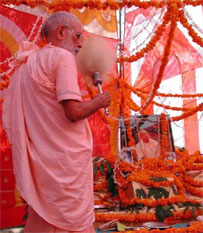
Srila Narayana Maharaja officiating
at the samadhi ceremony of Srila Prabhupada
Srila AC Bhaktivedanta
Swami Prabhupada
"They do not know
Krsna is God"
So the friends also were very much
obliged to Krsna. There was fire all round. They do not know anything. "Krsna."
"Yes." Krsna is ready. Krsna immediately swallowed up the whole fire. There were
so many demons attacked. Every day, all the boys, they would come back to their
home and explain to their mother: "Mother, Krsna is so wonderful. You see. This
happened to day." And the mother would say: "Yes, our Krsna is wonderful." So
much. That's all. They do not know Krsna is God, Krsna is the Supreme Person.
Krsna is wonderful. That's all. And their love increases. The more they perceive
Krsna's wonderful activities, they become more lover. "Perhaps he may be a
demigod. Yes." That is their suggestion. When Nanda Maharaja will talk amongst
his friends and the friends will talk about Krsna... "Oh Nanda Maharaja, your
child Krsna is wonderful. "Yes, I see that. Maybe some demigod." That's all.
"Maybe." That is also not certain. So the inhabitants of Vrndavana, they do not
care who is God, or who is not God. That is not their business. But they want Krsna and love Krsna. That's all.
How Deep
is the Mountain?
|
ISKCON Juhu
Beach temple, Mumbai, 1993
Tridandisvami Sri Srimad Bhaktivedanta Narayana Maharaja
[In 1993, in Srila
Prabhupada's quarters at the ISKCON Juhu Beach temple in Bombay, Srila Narayana Maharaja spoke to an audience of 200 devotees. He had
been requested at that time to share something of his relationship
with Srila Prabhupada, to describe some of the services he rendered
to Prabhupada in the past, and some of the services he has been
rendering to him since his divine disappearance in 1977.]
At the time of his divine departure from this world, Parama-pujyapada Srila Bhaktivedanta Svami Maharaja ordered me,
"You
should serve me in my taking samadhi." He knew the meaning and
significance of entering samadhi, and what should be done at that
time.
Samadhi is a Sanskrit word consisting of the two syllables: sama-dhi.
Sama means "the same" and dhi means "intelligence". It means that
the pure devotee who is departing from this world is entering the
same level, same position and same mood as the personal associates
of his worshipful deity _ with equal intelligence, equal beauty and
equal qualities. He is serving properly according to his own svarupa
(constitutional form). Srila Svami Maharaja's worshipful deity is Srimati Radhika, and he is serving Her under the guidance of Her
personal associates, the manjaris, headed by Sri Rupa Manjari.
He has preached about Lord Jagannatha-deva, Krsna-Balarama and other
manifestations of Sri Sri Radha-Krsna, but from what I have
understood from his writings, books, and personal darsanas, I am
determined in the fact that his worshipful deity is Srimati Radhika,
and he sees Sri Krsna as Radhika's beloved.
His desire was to assist Srimati Radhika in Her desire to serve Sri
Krsna in many various ways. He wanted at that time to be one with
the mood of Her maidservants, and in that very place where She
renders Her service. And he wanted my service at that time.
Sri Rupa Manjari serves Srimati Radhika when Radhika wants to meet
Krsna. For example, in the night, when it is dark, she dresses Her
in black clothes and ties Her ankle-bells so they will not make any
sound. She gives so much uddipana (stimuli) to Srimati Radhika's
bhava. For example, at the time of dressing Her she may put on a
necklace which has as its centerpiece the syamantaka jewel. At that
time she will say, "This jewel is the friend of Sri Krsna's Kaustaba
jewel." In this way she reminds Srimati Radhika of Her pastimes with
Lord Krsna, and Radhika bestows upon her all Her mercy.
If one can serve his Gurudeva in this mood, that is, in his Gurudeva's service to Sri Rupa Manjari or Sri Radhika, this is the
best service to Gurudeva.
I do not know why he gave me so much mercy that he chose me to give
him some uddipana as he entered his samadhi. I performed this
service by decorating him with tilaka and writing certain sacred
mantras on his chest with sandlewood paste _ indicating his services
to his worshipful deity, Srimati Radhika.
Just before his departure from this world, he requested me to sing
Sri Rupa-Manjari-Pada* (See Endnote 1):
sri rupa manari-pada, sei more sampada,
sei mora bhajana-pujana
["The lotus feet of Sri Rupa Manjari are my dearmost treasure. They
are the topmost object of my worship and inner devotional
practices.]
sei more prana-dhana, sei more abharana
sei mora jivanera jivana
["Her lotus feet are my most cherished wealth, more dear than my own
life. They are the exquisite ornament of my life, and indeed are the
very essence of my existence."]
This is the best sankirtana of Sri Rupa Manjari, who can lead us to Radhika's service. While I sang this I saw that his face was
sometimes colored with one transcendental mood and sometimes with
another. I had requested my brahmacari Sesaya to perform kirtana,
and I personally performed this kirtana for him _ just as I did for
my Gurudeva. There were many similarities between my Guru Maharaja, Srila Bhaktiprajnana Kesava Gosvami Maharaja, and Srila
Bhaktivedanta Svami Maharaja. I did what Srila Svami Maharaja
ordered me to do for him and I feel so fortunate that he gave me
this service; and I did the same for my Gurudeva at the time of his
entering samadhi.
Just before his departure, Srila Svami Maharaja told me, "You should
advise and help my disciples and all devotees connected with me." I
did not think I could help them at that time, for I considered them
higher in rank than myself. I thought, "They have so much guru-nistha,
faith in the lotus feet of their Gurudeva, and they are far more
advanced than I. They know, better than I, the conclusive truths of
the Krsna Consciousness philosophy (tattva-siddhanta). How can I
help them?" But my siksa-guru gave some inspiration in my heart.
It is sometimes thought that Srila Svami Maharaja is only in sakhya-rasa
_ that is, in his constitutional spiritual form he is a cowherd
friend of Krsna. When I hear this I experience pain in my heart, for
the complete conception of him is that he is in madhurya-rasa.* [See
endnote 2] Sakhya-rasa is included within madhurya-rasa, so sakhya-bhava is also within him, but he is in madhurya-rasa.* [See
endnote 3]
There are two ways to see our Gurudeva, and an analogy can be given
in this connection of the Himalayan Mountains. How high the
Himalayas are is one thing _ and how deep is another. We can
somewhat see its height, but we cannot see what is hidden deep
within the ground. We saw that Parama-pujyapada Srila Svami Maharaja
collected a large number of disciples throughout the world in
practically no time. We saw all varieties of his height. He loved
everyone, and everyone knew, "He loves me so much"; and we saw this
in our Guru Maharaja also.
How deep Sri Guru is, however, we cannot know. Srila Svami Maharaja
used to sing Sri Gurvastakam with a profound mood and with tears in
his eyes _ in samadhi. He did not see who was looking at him and who
was not, who was taking part and who was not. He was simply absorbed
in singing and playing his karatalas.
The first to fourth verses of Sri Gurvastakam contain very high
subject matter that we can realize and see, but there are two verses
that we cannot:
sri-radhika-madhavayor apara-
madhurya-lila-guna-rupa-namnam
prati-ksanasvadana-lolupasya
vande guroh sri caranaravindam (5)
["At every moment Sri Gurudeva is experiencing intense greed in his
heart to taste the unlimited sweetness of the holy names, forms,
qualities, and pastimes of Sri Sri Radha-Madhava in Vrndavana. I
offer my prayers unto the lotus feet of Sri Gurudeva."]
nikunja-yuno rati-keli-siddhyai
ya yalibhir yuktir apeksaniya
tatrati-daksyad ati-vallabhasya
vande guroh sri caranaravindam (6)
["Sri Gurudeva is always present with the sakhis, planning the
arrangements for the perfection of yugala-kisora's amorous pastimes
(rati-keli) within the kunjas of Vrndavana. Because he is so expert
in making these tasteful arrangements for Their pleasure, he is very
dear to Sri Radha and Krsna. I offer prayers unto the lotus feet of
Sri Gurudeva."]
Only one who is equal to his self-realized Guru can understand how
deep he is. A kanistha-adhikari, neophyte, and a madhyama-adhikari,
middle class devotee, cannot guess how deep are his feelings _ what
are the fathomless moods of krsna-prema and radha-prema in his
heart. Without being an uttama-adhikari, a topmost pure devotee, one
cannot understand.
Kanistha and madhyama-adhikari devotees can see his height, his aisvarya (opulence)
_ that he collected disciples and very quickly
preached all over the world _ but it is more valuable to see his
depth. Ultimately he has not collected disciples to experience his
height. He did that also, but he ultimately brought us only to give
us his deep thoughts. This will take time, of course; it could take
many births to realize something of this. When I see him and
remember his orders, I become moved _ knowing that he is engaged in nikunja-yuno rati-keli-siddhyai.
This is the main reason he came _ to give this service. He came to
obey the orders of Sri Caitanya Mahaprabhu, Nityananda Prabhu and
Sri Sri Radha and Krsna. But he had to spend a great deal of time
laying the groundwork by preaching vaidhi-bhakti.
Srila Prabhupada Bhaktisiddhanta Sarasvati Thakura has said, "I came
to give some valuable conceptions in raganuga-bhava _ but I could
not do so. Most of my life was spent in sweeping and cutting
jungles." Preaching is like this _ and it is also so essential.
Without preaching vaidhi-bhakti, that main thing cannot be given. Srila Sarasvati Thakura used to say that when the mayavada
philosophy (becoming one in all respects with an impersonal God) is
present, there can be no preaching of bhakti _ so we will have to
cut the jungles of atheism, mayavada, sahajiyaism and other
non-Vedic philosophies. We will have to spend time defeating their
arguments.
I think that I have some very little role in this _ to obey his
orders. If I can give raganuga-bhakti in the hearts of devotees, I
will see that I have fulfilled the orders he has given me. This is
the best service I can render to his lotus feet. When you are
situated in raganuga-bhakti, you will be able to factually see that
his relationship with Sri Sri Radha and Krsna is in gopi-bhava. Then
you can deeply think of his services to the Divine Couple in nikunja
yuno rati keli siddhyai.
He used to sing daily:
jaya radha-madhava jaya kunja-bihari
gopi-jana-vallabha jaya giri-vara-dhari
yasoda-nandana, braja-jana-ranjana
yamuna-tira-vanacari
["All glories to Sri Radha-Madhava! All glories to Kunja-Bihari, who
is the gopis dearmost beloved. He lifted Govardhana Hill and is the
darling son of Yasoda Maiya. He wanders in the forests along the
banks of the Yamuna, where He enjoys with the many different gopis
in their own groves."]
He has so much transcendental greed to serve Kunja-bihari. A sakha
does not have the sentiments and thoughts of these exalted
conceptions. The name Gopi-jana-vallabha in this song is also in our
gopala-mantra. Srila Svami Maharaja desired to give the service
performed by the gopis to Gopi-jana-vallabha, but he saw that there
were only a few in this world who were qualified for this _ the
number could be counted on ones fingers. In order to gradually bring
his audiences to a level wherein they could understand, he preached
about Lord Jaganatha-deva and established deities of Sri Sita-Rama
and Sri Krsna-Balarama.
The gopis have spoken about Rama-Krsna (Balarama is sometimes called
Rama) in Srimad-bhagavatam, but they were not actually referring to
Rama meaning Balarama. They were indicating Ramanya-Krsna; that is, Krsna, the enjoyer of Sri Radha. Their Rama is Krsna Himself.
Qualified devotees _ those who have received the mercy of their Gurudeva
_ will actually realize this; and others who desire to do
so will realize it after some time.
If I can render this service to his lotus feet _ to give an atom of
the feelings of these exalted conceptions to his disciples and
followers, I will render him the best service.
[*Endnote 1. He very much liked, "Hari Haraye Namah Krsna Yadava
Namah", "Jaya Radhe, Jaya Krsna, Jaya Vrndavana." and "Sri Rupa
Manjari-Pada", and used to request me to sing these kirtanas. (UK
Visit to Srila Prabhupada's Room at Bhaktivedanta Manor 1996 May 17)
2. To explain the topmost quality of conjugal love, Srila Krsnadasa
Kaviraja Gosvami gives the example of the material elements__sky,
air, fire, water and earth. In the sky (space) there is the quality
of sound. Similarly, in air there are the qualities of sound and
touch. In fire, there are three qualities__sound, touch and form. In
water there are four qualities__sound, touch, form and taste.
Finally, in earth there are all five qualities__sound, touch, form,
taste and also smell. Now, one can see that the quality of the sky
is in all__namely in air, fire, water and earth. In earth we can find
all the qualities of material nature. The same can be applied to the
rasa known as madhurya-rasa, or conjugal love. In conjugal love
there are the qualities of neutrality, servitorship, fraternity and
parental affection, as well as those of conjugal love itself. The
conclusion is that through conjugal love the Lord is completely
satisfied.
3. Conjugal love (madhurya-rasa) is also known as srngara-rasa. It
is the conclusion of Srimad-Bhagavatam that in the complete
combination of loving service to the Lord__namely in conjugal
love__the Supreme Lord fully agrees to be under the control of the
devotee. (Sri Caitanya-caritamrta Madhya-lila, 8.88)]
Editorial advisors: Sripad Madhava Maharaja and Sripad Brajanatha
dasa
Transcriber and typist: Vasanti dasi
Editor: Syamarani dasi
|
www.SrilaPrabhupada.com
The Pure Conception Of Who Srila Prabhupada Is
And What He Has Come To Give Us

Please accept our dandavat pranams
All glories to Sri Guru and Sri Gauranga
All glories to Sri Sri Radha Vinode Bihariji
Srila Prabhupada's Last
Conversation
"The cassette was kindly provided by the BBT Archives.
This recording was in Bengali, and that's
why it wasn't distributed, here is the transcription"
Srila Prabhupada: Narayana Maharaja. He will come tomorrow?
Tamal Krsna Gosvami: He will come when we (discussing with others). If
we pick him up he might come tonight.
Srila Prabhupada: Hmm.
Tamal Krsna Gosvami: If we go just now with the car. Bhakticaru is
going just now with the car. Maharaja may come tonight.
(Someone begins to sing govindam adi purusam...)
Tamal Krsna Gosvami: Yeah, Srila Prabhpada. Should we put a little fan
on? A little bit.
(The conversation with Srila Narayana Maharaja begins:)
Srila Prabhupada: Prabhupada (Srila Bhaktisiddhanta Sarasvati Thakura)
had a desire to preach all over the world - in Europe, America...I tried my best
to fulfill his desire. Now we should preach together.
Srila Narayana Maharaja: Yes.
Srila Prabhupada: We have got experience that if we endeavor
collectively, there is great possibility to spread the message of akara matha:
the mission of Mahaprabhu, 'prithvi te ache, everywhere in the world. I
have contributed to this end to the best of my ability.
Srila Narayana Maharaja: Hmm.
Srila Prabhupada: I wish that my god-brothers forgive my
offenses...While preaching, many times we do say things contrary to each other,
or we cut each other's philosophical arguments. That happens. Please ask my
god-brothers to forgive my offences...(inaudible)
Srila Narayana Maharaja: All right.
Srila Prabhupada: (inaudible)?
Srila Narayana Maharaja: Whatever you will order I will accept
completely. I consider you as my Guru.
Srila Prabhupada: (inaudible)?
Srila Narayana Maharaja: It has been done very beautifully. This is
the proper way. It's good that you have raised this point __ that everyone should
protect the mission of Mahaprabhu that you have established in Western
countries, by good cooperation. Though you have taught them, still, in the
future if everyone helps them, a wonderful movement can be established on the
Earth.
Srila Prabhupada: (inaudible)...I have brought these monkeys. Accepting those who were sent to me, and considering their
qualifications and disqualifications, I tried educating them, just to get things
going. They learned to their capacity. Things can be done in good cooperation.
There is enough land, big big temples, and no shortage of money...(inaudible)
Srila Narayana Maharaja: It's proper for everyone to help in this
matter. Everything will be still better if they are also humble and try to
cooperate with everyone, with each other as well as with other Vaisnavas. I will
do my best to help. Whenever and whatever they will ask, I will try my best to
help them. Whenever they will call me, any advice they will want, wherever they
may want me to go, although my qualification is limited, I will try to help to
the best of my ability.
Srila Prabhupada: Are any of my god-brothers in Vrndavana now?
Srila Narayana Maharaja: Yes.
Srila Prabhupada: Who?
Srila Narayana Maharaja: Van Maharaja might be there, as well as Indupati Prabhu from Caitanya Gaudiya Matha.
Srila Prabhupada: Any more?
Srila Narayana Maharaja: Only these two at the moment.
Srila Prabhupada: Who is Indupati?
Srila Narayana Maharaja: Indupati. He comes here often.
Bhakticaru Swami: From Madhava Maharaja's matha?
Srila Narayana Maharaja: Yes. No one else is here.
Srila Prabhupada: Please call both of them. Van Maharaja and him.
Srila Narayana Maharaja: This is very good proposal by you.
Srila Prabhupada: Please sit down. They will call them.
Srila Narayana Maharaja: All right.
Srila Prabhupada: This cutting of arguments happens sometimes...
Srila Narayana Maharaja: These are insignificant matters in such a
substantial worldwide mission. A little something here and there is of no
consequence. You have done this wonderful preaching work for the benefit of the
whole world. There was no self-interest. You did everything only in devotional
service to Krsna - for benefitting all people at large.
Srila Prabhupada: It is all by your blessings.
Srila Narayana Maharaja: You have done a wonderful thing. It is
necessary to care for and preserve this mission, and see that it is managed
skillfully.
Srila Prabhupada: YOU KINDLY INSTRUCT THEM ON THIS MATTER. I'm unable
to speak.
Srila Narayana Maharaja: Yes. Please take rest.
Srila Prabhupada: Please sit a little longer.
Srila Narayana Maharaja: Yes. I'm here.
Srila Prabhupada: Your health is all right?
Srila Narayana Maharaja: Yes. You please keep remembering about Krsna.
These are all very qualified men. They will manage nicely.
Srila Prabhupada: There is some problem (disturbance) in Mayapura.
Srila Narayana Maharaja: That will all be worked out. The gundas have
done that for there selfish motives. Everything will be all right. Some
obstacles are always there in any work.
Srila Prabhupada: Twenty thousand people gathered for the meeting.
Have you heard anything about it?
Srila Narayana Maharaja: Yes I have heard something. It was painful.
The communist party people have done that nonsense. They have done utmost
injustice. Now be free to peacefully remember Sri Radha-Krsna and Their sweet
pastimes. Your people will take care of the necessities. All will be well by the
wish of the Supreme Lord, Sri Krsna. No need to think about it at all.
Srila Prabhupada: Hmm.
Srila Narayana Maharaja: You don't worry.
Srila Prabhupada: You have some affection for me? [This is an Indian
expression of love.]
Srila Narayana Maharaja: Affection! What to speak of affection, I
regard you as my Guru.
Srila Prabhupada: I know that. That's why I beg you to please forgive
my offenses.
Srila Narayana Maharaja: You kindly forgive our offenses, so that our
intelligence may be fixed at the lotus feet of Krsna. Please give us this
blessing.
Srila Prabhupada: Where is...
Srila Narayana Maharaja: He has gone to Bengal.
Srila Prabhupada: When did he go?
Srila Narayana Maharaja: He went about a month ago. Sesyai has come
with me to take your darshan. He has rendered some services to you.
Srila Prabhupada: Brahmachari?
Srila Narayana Maharaja: Yes Sesyai Brahamacari. Sometimes he has
cooked for you.
(Srila Narayan Maharaja speaks to the other devotees in Hindi:) He used to
cook for Swamiji when he was in Mathura.)
Srila Prabhupada: Where is Tamal?
Devotee: He is just coming, Srila Prabhupada. He is in the other room.
Srila Prabhupada: (inaudible)
Srila Narayana Maharaja: Yes, I can see that. It is very good that you
have returned to Vraja from overseas.
Srila Prabhupada: They wanted to keep me there, but I said, "No". My
health is not fit for anymore travel...
(Tamal Krsna Gosvami enters the room)
Srila Prabhupada: Have you consulted with Narayana Maharaja?
Tamal Krsna Gosvami: Yes. This morning. Bhakticaru Swami, Bhaktiprema
Swami and Sridhara Swami went to see him, and Narayana Maharaja described the
ceremony.
Srila Narayana Maharaja: I have told them everything needed to be
done. I have said, "Whenever you need me, I'll come here."
Srila Prabhupada: (inaudible)...When you enter in the gate on the
right side?
Tamal Krsna Gosvami: On the entrance on the left side. On entering,
looking towards the Deities. In other words, when you come into the temple.
There is a big open...
Srila Prabhupada: You must put salt around the body.
Srila Narayana Maharaja: I have explained to them everything.
Tamal Krsna Gosvami: It's on the same side as the vyasasana.
Srila Prabhupada: Flowers should be placed in Mayapura.
Srila Narayana Maharaja: I have told them to keep some flowers, and
wherever you desire those can be...
Srila Prabhupada: You be there.
Srila Narayana Maharaja: Yes, I'll be there.
Tamal Krsna Gosvami: He described the entire ceremony in detail, Srila
Prabhupada.
Srila Prabhupada: (inaudible)...Has Sesyai taken sannyasa?
Srila Narayana Maharaja: No. He is still a brahmacari.
Srila Narayana Maharaja: All of your duties are completed. You have
fulfilled everything in your lifetime. There is no need to worry for anything.
Only remember the lotus feet of Sri Radha-Krsna.
Srila Prabhupada: By Their blessings only.
Srila Narayana Maharaja: Yes, you have done everything. Nothing is
left unfinished.
Srila Prabhupada: Hm.
Srila Narayana Maharaja: Only one thing. They should be told not to
fight with each other for self-interest. They should work in cooperation to
spread your mission.
Srila Prabhupada: Don't fight among yourselves. I have given you my
will. Execute that...Today is Ekadasi?
Srila Narayana Maharaja: Yes, today is Ekadasi.
Srila Prabhupada: How is the service of Mahaprabhu going on?
Srila Narayana Maharaja: Hmm.
Srila Prabhupada: Of Jhansi. Now he is at your place.
Srila Narayana Maharaja: Yes, your Mahaprabhu is with me. His service
is going on nicely with great affection.
Srila Prabhupada: At first I was trying to do something in Jhansi, but Krsna had bigger plans. We have got so many places.
Srila Narayana Maharaja: Why should you be confined in Jhansi? Krsna
wanted you to preach everywhere.
Srila Prabhupada: I wanted to live like a niskincana Vaishnava in
Vrindavan; but Krsna inspired me to go out and preach at the age of seventy with
only forty rupees in my pocket. And then it took a grand shape.
Srila Narayana Maharaja: Yes, you have received the special mercy of
Sri Rupa Gosvami, and also that of Sri Radha-Damodara.
Srila Prabhupada: (inaudible)
Srila Narayana Maharaja: Do you have any pain in the body?
Srila Prabhupada: It's so so... (inaudible)
Srila Narayana Maharaja: (speaks to the devotees:) Give him
caranamrta when he feels thirsty. Also, keep some tulsi leaves under his
head.
Srila Prabhupada: Yei bhaje sei bado... "One who worships Krsna
is exhalted..."
Srila Narayana Maharaja: Hmm. Sei bado. "He is exhalted."
Srila Prabhupada: Abhakta hina char. "One who is a non-devotee
is low-class and abominable."
Srila Narayana Maharaja: Char. "Abominable."
Srila Prabhupada: (inaudible)
Srila Narayana Maharaja: They are fortunate. If one has single pointed
devotion to Lord Hari, then, even if he has any faults, "api cet suduracaru
bhajate mam ananya bhak, sadhur eva sa mantavya samyak vyavasthito hi sa".
This is the principle.
(Indupati Prabhu enters in the room)
Indupati Prabhu: Hare Krishna.
Srila Narayana Maharaja: Please come. Has Van Maharaja also come?
Indupati Prabhu: (inaudible)
Srila Narayana Maharaja: Indupati prabhu has come.
Srila Prabhupada:...Narayana Maharaja has called you on my request. I
was saying to Narayana Maharaja that I beg forgiveness from you....
Indupati Prabhu: Hmm...
Srila Narayana Maharaja: (speaking softly to Indupati prabhu.)
Maharaja is having difficulty in speaking. I'll tell you.
Srila Prabhupada: I beg forgiveness for my offenses. I did not wish to
offend anyone. While preaching sometimes we cut each other's arguments...
Srila Narayana Maharaja: (he is softly explaining Srila Prabhupada's
desire to Indupati prabhu.)
Srila Prabhupada: Will you forgive me?
Srila Narayana Maharaja: (to Indupati Prabhu) Will you?
Srila Narayana Maharaja: (to Srila Prabhupada) Maharaja, you have not
committed any offence. Please be merciful to us. You haven't committed any
offence.
Indupati Prabhu: (inaudible)
Srila Narayana Maharaja: If anyone considers that you have committed
an offence, then he himself is at fault.
Srila Prabhupada: Hmm...?
Srila Narayana Maharaja: (speaking softly to Indupati Prabhu about
Srila Prabhupada:] He has just returned from London.
Srila Prabhupada: They had arranged the world tour program, but I had
to return...
Srila Narayana Maharaja: I will speak to those disciples of Srila
Prabhupada (Bhaktisiddhanta Sarasvati Thakura) who are not here about your wish.
Everyone should try to help and give them (your disciples) the needed guidance,
so they can manage nicely. Please do not worry about anything. Remember only the
lotus feet of Sri Radha-Krishna.
Srila Prabhupada: Please guide them in arranging the festival properly
and giving appropriate donations to the gosvamis...
Srila Narayana Maharaja: (to Bhakticaru Svami) Have you understood
what he is saying?
Bhakticaru Svami: Yes. (He softly speaks with Srila Narayana
Maharaja.)
Srila Narayana Maharaja: I have a special request. Please do not worry
about these matters anymore. They are qualified and they know your desires. Now
only think about Krsna. Everything will be taken care of. You have made the
whole world dance in Krsna Nama.
Srila Narayana Maharaja: Now I'll take leave.
Srila Prabhupada: First take some prasada.
Srila Narayana Maharaja: Yes I'll take.
Bhakticaru Svami: Srila Prabhupada, I'm arranging that.
(Srila Narayana Maharaja leaves.)
[Credit for the translation is due mostly to the efforts of Sripad Madhava
Maharaja, Sripad Krsna Kanthi dasa brahmacari, and Sripad Tanmoy Chakravarty.
Although the volume of the original cassette was improved by digital technology,
still some parts remain inaudible, and in the above transcription they are
labeled as such.]
19940317-20_Bhakti Caru Swami About Narayan Maharaja
More About Srila Prabhupada
www.bvml.org
The Homonym Iskcon

BY SYAMARANI DASI

There was an article published on the Cakra website, attempting to show
that Srila Narayana Maharaja's teachings are different from those of
Srila Prabhupada, and trying to discourage devotees from hearing from
him. This compilation, full of quotes gathered by an ISKCON Gurukula
teacher, was also translated and distributed in Mexico during Srila
Maharaja's recent visit there. The ideas expressed in the compilation
have already been refuted repeatedly over the years on the Internet.
Still, because the compilation has just been translated into Spanish, we
are again replying for the sake of new readers.
In this present article we will state the same quotes of Srila Narayana
Maharaja used in the compilation, along with quotes from Srila
Prabhupada confirming Srila Maharaja's statements. Knowing that every
one of us understands both life and scripture according to our millions
of births of impressions, sukrtis and samskaras, the author humbly
requests the respected reader to consider the points presented herein in
the light of your highest aspiration. Decide as you like.
The compilation posted on Cakra is called 'Understanding Narayana
Maharaja: his own words and other primary sources'. Let us first of all
consider the meaning of the title, which may lead the reader to think
that it is accurately representing Srila Maharaja's words. Actually, his
words are many times taken out of context, and sometimes simply changed.
Moreover, in the ISKCON compilation, the 'primary sources' are not even
credible.
When quoting the compilation, we shall begin with the word
'COMPILATION', and we will begin our own statements with the word
'REFUTATION'. Because the compilation is very lengthy and contains so
many ideas, we shall discuss only half of those ideas in this article
and more of them in articles to come. Our article is quite long, but we
beg your indulgence, for a careful reading will clear the matter.
Otherwise, you are quite welcome to browse:
COMPILATION 1: Narayana Maharaja on A.C. Bhaktivedanta Swami Prabhupada
and ISKCON
Narayana Maharaja Germany: Dec 12, 2001:
"My siksa-guru, nitya-lila-pravista Om visnupada Sri Srimad
Bhaktivedanta Swami Maharaja."
Narayana Maharaja Mathura, October 24, 1999:
"We can glorify Swamiji, Bhaktivedanta Swami Maharaja. But those who are
falling down, how can they glorify him? They cannot glorify him, never;
they are cutting. They are establishing that he was the founder of ISKCON, but I know that he was not founder, he was one of the members of
this in guru parampara. It was founded by Krishna, and first acarya was
Brahma, then Narada, then Vyasa. Only he has changed the name and he has
preached these things in Western countries."
REFUTATION 1: The compilation's use of Srila Maharaja's quotes, saying
that he is the siksa disciple of Srila Prabhupada and then saying that
Srila Prabhupada is not the founder-acarya of ISKCON, is meant to show
that he is not really Prabhupada's disciple. But Srila Maharaja is
saying nothing that Srila Prabhupada has not said many times. In his
Bhagavad-gita Preface Srila Prabhupada says:
"Some of them said that it is greatly fortunate for the Americans that I
have started the Krsna consciousness movement in America. But actually
the original father of this movement is Lord Krsna Himself, since it was
started a very long time ago, but is coming down to human society by disciplic succession. If I have any credit in this connection, it does
not belong to me personally, but it is due to my eternal spiritual
master, His Divine Grace Om Visnupada Paramahamsa Parivrajakacarya 108
Sri Srimad Bhaktisiddhanta Sarasvati Gosvami Maharaja Prabhupada. If
personally I have any credit in this matter, it is only that I have
tried to present Bhagavad-gita as it is, without any adulteration.
Before my presentation of Bhagavad-gita As It Is, almost all the English
editions of Bhagavad-gita were introduced to fulfill someone's personal
ambition. But our attempt, in presenting Bhagavad-gita As It Is, is to
present the mission of the Supreme Personality of Godhead, Krsna."
Srila Prabhupada also writes in his purport to Srimad-Bhagavatam 2.9.6:
"Thus Brahma was initiated by the Krsna mantra, by Lord Krsna Himself,
and thus he became a Vaisnava, or a devotee of the Lord, before he was
able to construct the huge universe. It is stated in the Brahma-samhita
that Lord Brahma was initiated into the eighteen-letter Krsna mantra,
which is generally accepted by all the devotees of Lord Krsna. We follow
the same principle because we belong to the Brahma sampradaya, directly
in the disciplic chain from Brahma to Narada, from Narada to Vyasa, from Vyasa to Madhva Muni, from Madhva Muni to Madhavendra Puri, from Madhavendra Puri to Isvara Puri, from Isvara Puri to Lord Caitanya and
gradually to His Divine Grace Bhaktisiddhanta Sarasvati, our divine
master."
COMPILATION 2: Narayana Maharaja 28th April 1999, morning, Caracas:
"Also you should know that Caitanya Mahaprabhu is the founder of ISKCON.
Swamiji, AC Bhaktivedanta Swami Maharaja is one of the prominent acaryas
in this line only. He is not founder; he's one of the prominent acaryas,
who spread all these things [over] whole world, in a very short time.
REFUTATION 2: The compilation is trying to say that Srila Narayana
Maharaja does not respect Prabhupada's position as founder-acarya of
this movement. But actually, he is establishing Prabhupada's glory. With
pride, Srila Prabhupada confirms Srila Maharaja's statement in his own
Srimad-Bhagavatam purport. There he says: "The Hare Krsna movement is
not a new movement as people sometimes mistakenly think. The Hare Krsna
movement is present in every millennium of Lord Brahma's life, and the
holy name is chanted in all the higher planetary systems, including Brahmaloka and Candraloka, not to speak of Gandharvaloka and Apsaraloka.
The sankirtana movement that was started in this world five hundred
years ago by Sri Caitanya Mahaprabhu is therefore not a new movement.
Sometimes, because of our bad luck, this movement is stopped, but Sri Caitanya Mahaprabhu and His servants again start the movement for the
benefit of the entire world, or indeed, the entire universe." (SB
7.15.72 Purport)
In his Srimad-Bhagavatam 1.9.6-7 purport, Srila Prabhupada lists some of
the other prominent acaryas in this movement. He writes: "He (Narada) is
the son and disciple of Brahmaji, and from him the disciplic succession
in the line of Brahma has been spread. He initiated Prahlada Maharaja, Dhruva Maharaja and many celebrated devotees of the Lord. He initiated
even Vyasadeva, the author of the Vedic literatures, and from Vyasadeva, Madhvacarya was initiated, and thus the Madhva-sampradaya, in which the Gaudiya-sampradaya is also included, has spread all over the universe.
Sri Caitanya Mahaprabhu belonged to this Madhva-sampradaya; therefore, Brahmaji, Narada, Vyasa, down to Madhva, Caitanya and the Gosvamis all
belonged to the same line of disciplic succession."
Prabhupada confirms in this next quote that he is coming in the line of
Caitanya Mahaprabhu. He writes: "Our original sampradaya stems from
Madhvacarya. In that sampradaya there was Madhavendra Puri, and Madhavendra Puri's disciple was Sri Isvara Puri. Sri Isvara Puri's
disciple was Lord Caitanya Mahaprabhu. Thus we are coming in the
disciplic succession from Sri Caitanya Mahaprabhu, and therefore our sampradaya is called the Madhva-Gaudiya-sampradaya. It is not that we
have manufactured a sampradaya; rather, our sampradaya stems from Lord
Brahma." (Teachings of Lord Kapila, chapter 14, text 31)
Thus, to be a prominent acarya in this line is the greatest glory.
COMPILATION 3: Narayana Maharaja Murwillumbah, Australia: Feb. 18, 2002
(eve):
"Your Prabhupada, Srila Swami Maharaja, only changed the name into
English. He is not the founder-acarya of that eternal ISKCON... I am
ISKCON. I'm not different from ISKCON. I am 'Bhaktivedanta' [Srila
Bhaktivedanta Narayana Gosvami Maharaja]. Like father, like son. I am
the real successor of Srila Bhaktivedanta Swami Maharaja, and there is
no other. You should know this very openly. I am Bhaktivedanta and he is
Bhaktivedanta, but he received this name after I did. I'm senior to him
in this regard... I'm Bhaktivedanta, and I'm also ISKCON. Don't think
that I'm out of ISKCON."
REFUTATION 3: COMPILATION 3 did not quote this accurately. By this
inaccurate quote it wants to say that Srila Narayana Maharaja is trying
to usurp Prabhupada's position as founder-acarya. But the truth is that
Srila Maharaja is actually revealing his pride in being Prabhupada's
humble servant. The compilation did not include the preceding sentences
and explanation, and it also substituted an important clarification with
a mere three dots. The following is the actual version of the statement
as it was posted on the Internet. (The words in brackets, also included
in the Internet posting, were ours:)
"At the time of Srila Bhaktisiddhanta Sarasvati Gosvami Thakura, Srila
Sarasvati Thakura was the president of ISKCON. He sent one arm, Srila
Prabhupada Bhaktivedanta Swami Maharaja, who was given sannyasa by Srila
Bhakti Prajnana Kesava Gosvami Maharaja, and who then gave ISKCON its
English name [Previously it was called by different names, like Gaudiya
Vedanta Samiti,* Gaudiya Matha, Visva Vaisnava Raja Sabha, and Krsna-bhakti-rasa bhavitah mati.] Your Prabhupada, Srila Swami Maharaja,
only changed the name into English. He is not the founder-acarya of that
eternal ISKCON. [Srila Prabhupada sometimes said he was the founder-acarya
for two reasons: for management and legal purposes, and also for the
faith of his young disciples who would not have understood another
presentation at that time.] The founder-acarya is originally Brahma, and
it was actually established by Krsna. All of you who are following this
disciplic succession are ISKCON. Don't think that you are not. I am
ISKCON. I'm not different from ISKCON. I am 'Bhaktivedanta' [Srila
Bhaktivedanta Narayana Gosvami Maharaja]. Like father, like son. I am
the real successor of Srila Bhaktivedanta Swami Maharaja, and there is
no other. You should know this very openly. "I am Bhaktivedanta and he
is Bhaktivedanta, but he received this name after I did. I'm senior to
him in this regard. By my request he became ready to take sannyasa, and
my Guru Maharaja gave sannyasa to him. [Srila Narayana Maharaja and
Srila Prabhupada were both given the name Bhaktivedanta by Srila
Bhaktiprajnana Kesava Gosvami Maharaja at the time of their sannyasa
initiations.] I was like the priest at his sannyasa ceremony. I
performed the fire sacrifice, I made his danda and I taught him how to
wear his sannyasa garments. Although he is junior to me and I'm senior
to him in sannyasa, he is my siksa-guru. I'm his disciple. I'm Bhaktivedanta, and I'm also ISKCON. Don't think that I'm out of ISKCON."
We had also posted the following quote by Srila Prabhupada along with
Srila Maharaja's lecture, confirming Srila Maharaja's statement.
Prabhupada had stated in a lecture in Detroit, on August 3, 1975: "It is
not that, 'Bhaktivedanta Swami has brought this.' They say. They give me
the credit. That is my good fortune also. But actually I am just like a
peon. I have brought, but I am delivering it without any adulteration.
That may be my credit. And if you take it without any adulteration and
practice it, then your life is successful."
Moreover, Srila Maharaja's above-mentioned statement was preceded by his
introduction, but this was also not quoted in the compilation. Srila
Maharaja began his lecture with these words: "You should know one thing. ISKCON was first established by catur-mukha (four-headed)
Brahma. He is our first guru. He is the original founder-acarya of ISKCON, and his
disciples like Sanaka, Sanandana, Sanatana, Sanat-kumara, and Narada are
real ISKCON preachers. After them, especially in Kali-yuga, Madhvacarya, Ramanuja, Visnuswami, Nimbaditya, and so many others appeared. In our
line (the Gaudiya sampradaya), especially in Kali-yuga, Sri Madyavendra
Puri is the root, the seed. His disciples are Srila Isvara Puripada and
Nityananda Prabhu; from Isvara Puripada came Sri Caitanya Mahaprabhu,
and from Him came Svarupa Damodara. Then, after them, Srila Bhaktivinoda
Thakura and Srila Prabhupada Bhaktisiddhanta Sarasvati Gosvami Thakura
appeared in their line, and they are also part of the real ISKCON. All
these are ideal ISKCON personalities, and you should always be aware of
this."
Srila Maharaja is simply encouraging us to remember to honor our
previous acaryas. They can also help us and bless us. If we think that
Prabhupada is the first in this movement, we are not glorifying him. He
does not want to be disconnected from his guru-parampara. His glory is
his chastity to the words and moods of his disciplic succession. If we
think that Prabhupada is first, it means we think we don't have to refer
to the previous acaryas of the succession to understand what he is
trying to teach. It means we think that we, and conditioned souls like
us, are the authorities on understanding him.
Regarding Srila Maharaja's statement that he, as well as others, can
also be given the title 'Bhaktivedanta', Srila Prabhupada confirms this
in Srimad-Bhagavatam 1.5.24 as follows: "As such, vedanta-vadis, or the
followers of the Vedanta, indicate the pure devotees of the Personality
of Godhead. Such vedanta-vadis, or the bhakti-vedantas, are impartial in
distributing the transcendental knowledge of devotional service. To
them, no one is enemy or friend; no one is educated or uneducated. No
one is especially favorable, and no one is unfavorable. The bhakti-vedantas
see that the people in general are wasting time in false sensuous
things. Their business is to get the ignorant mass of people to
re-establish their lost relationship with the Personality of Godhead. By
such endeavor, even the most forgotten soul is roused up to the sense of
spiritual life, and thus being initiated by the bhakti-vedantas, the
people in general gradually progress on the path of transcendental
realization."
In his lecture on Aug. 5, 1975, Prabhupada says further: "So some of the Vaisnavas selected me to get this title Bhaktivedanta. Vedanta means
bhakti, understanding bhakti. Because vedais ca sarvair aham eva vedyah
[Bg. 15.15]. So who can understand Krsna unless he has bhakti? So this
is the bhaktivedanta."
Srila Maharaja's diksa-guru, Srila Bhaktiprajnana Kesava Maharaja is
also his sannyasa-guru. Srila Maharaja's diksa-guru is also the sannyasa-guru
of Srila Prabhupada. Srila Bhaktiprajnana Kesava Maharaja gave all his
sannyasa disciples the title 'Bhaktivedanta'.
The compilation quoted Srila Maharaja saying, "I am the real successor
of Srila Bhaktivedanta Swami Maharaja, and there is no other." Perhaps,
by doing this, the compilation is trying to say that Srila Maharaja is
not bona fide because a self-effulgent acarya does not need to proclaim
himself. But the compilation is wrong in its assumption. Surely Srila
Maharaja is only separating himself from the hundreds of pretenders who
masquerade as gurus, and there is no harm in that. This statement is not
exclusive but inclusive. When Prabhupada was asked in 1969 in Boston
what Jesus meant when he said I am the only son of my father. No one can
come to Him but through me, Prabhupada replied, "He means, 'by me or
anyone like me; in other words, by me or any bona fide representative of
God.'" Similarly 'guru is one', as we have heard, and at the same time
there is more than one bona fide guru. Srila Maharaja is not disparaging
other bona fide teachers. He is simply saying that it is no small thing
to perfectly represent the line of Gaudiya acaryas.
Srila Maharaja's statement can also be seen in this way: His is the
statement of a son who loves his father (Prabhupada) so much that he can
say that "No one can love my father as much as I." This is not at all
pride in himself, but in his beloved Srila Swami Maharaja, our Srila
Prabhupada. We cannot imagine such love in our Western culture.
COMPILATION 4: Hari Sauri 3/31/97 7:54 AM Letter:
"He (Narayana Maharaja) shouted, 'I am not under your rules. I am not ISKCON, I am Gaudiya
Math!'"
REFUTATION 4: The compilation is trying to say that Srila Maharaja
contradicts himself to suit his purposes. But actually, he is putting a
spotlight on the real eternal ISKCON, and distinguishes it from the
modern corporate ISKCON. The incident referred to above took place in
Navadvipa. Hari Sauri and a few of his god-brothers were trying to
chastise Srila Maharaja in harsh language. They had been accusing him of
re-initiating Gaurangi dasi, who had actually never been initiated
before. They had also been accusing him of initiating her on his first
meeting with her, without seeing her qualifications. They said that Prabhupada's disciples waited six months and that this was only
Gaurangi's first day. But actually she had been born into Krsna
consciousness, had been practicing about twenty years, had read deeply
into both Prabhupada's and Srila Narayana Maharaja 's books, and had
been recommended by several senior devotees. Srila Maharaja replied to
them, without shouting, that he was not part of their [corporate] ISKCON, and therefore they were not his authorities. His statement did
not at all imply that he felt himself beyond the rules of eternal ISKCON.
In his lecture of May 13, 200l, in Los Angeles, California, Srila
Maharaja explained Prabhupada's glory in relationship to the eternal
ISKCON. The following are some excerpts. (The words in brackets is our
introduction to this lecture which was posted on the Internet.)
[In these days of confusion, strife and doubt, tens of thousands of
devotees around the world who had dedicated their lives with a desire to
serve Srila Prabhupada's mission are now becoming more and more inclined
to find out the true facts about that mission. What is truly ISKCON? Who
are actually ISKCON members and what are their moods? Can a true member
of ISKCON ever fall? Who are the real ISKCON leaders and how do we serve
them? The astonishing answers to these questions are revealed by Srila
Narayana Maharaja in the following lecture.]
"If you have no love and affection and you are worshiping Krsna with
sixteen different types of paraphernalia, Krsna will not accept your
worship. And, if you have no paraphernalia to offer besides one drop of
water or a leaf of tulasi, but you offer it with great love and
affection, Krsna will be satisfied. Even if you do not offer any water
or tulasi, but you say, "O Krsna, I am Yours and You are mine." - this
will suffice. We should try to follow this principle.
"Caitanya Mahaprabhu requested Raya Ramananda to speak on this subject,
and Raya Ramananda said:
krsnah bhakti rasa bhavita matih
kriyatam yadi kuto 'pi labhyate
tatra laulyam api mulyam ekalam
janma-koti-sukrtair na labhyate
[Devotee reads Prabhupada's translation:] 'Pure devotional service in
Krsna consciousness cannot be had even by pious activities in hundreds
and thousands of lives. It can be obtained only by paying one price;
that is, intense greed to obtain it. If it is available somewhere, one
must purchase it without delay. Purport: The previous two verses are in
included in the Padyavali (13, 14) by Srila Rupa Gosvami.'
[Srila Narayana Maharaja:] "You should hear this very carefully. Bhakti
begins from here."
[Devotee reads:] 'Verse 69 refers to devotional service in faith and
verse 70 refers to devotional service rendered out of intense greed. The
first is devotional service rendered in accordance to the regulative
principles, and the second refers to spontaneous loving service to the
Lord without extraneous endeavor. Henceforward the basic principle
underlying the talks between Sri Caitanya Mahaprabhu and Ramananda Raya
will be spontaneous loving service to the Lord. The regulative
principles according to the injunctions of the sastras are necessary
insofar as one's original dormant Krsna Consciousness is not
spontaneously awakened. An example of spontaneous action is the flowing
of rivers into the ocean. Nothing can stop the flow of water. Similarly,
when one's dormant Krsna consciousness is awakened, it spontaneously
flows to the lotus feet of Krsna without impediment. Whatever will be
spoken henceforth by Ramananda Raya based on spontaneous love will be
agreeable to Caitanya Mahaprabhu, and the Lord will ask him more and
more about this subject.'
[Srila Narayana Maharaja:] "I have seen that Srila Swami Maharaja has
given the definition of ISKCON with this sloka: krsnah bhakti rasa
bhavita. This is the basis of ISKCON."
[Srila Prabhupada is quoted here from the book Journey to
Self-Discovery:] "In another verse, Rupa Gosvami says, krsna-bhakti-rasa-bhavita matih kriyatau yadi kuto 'pi labhyate. I have
translated the words Krsna consciousness from krsna-bhakti-rasa-bhavita.
So here Rupa Gosvami advises, 'If Krsna consciousness is available,
please purchase it immediately. Don't delay.' It is a very nice thing."
In Vrndavana, March 13, 1974, Prabhupada stated: "Rupa Gosvami advised, krsna-bhakti-rasa-bhavita matih kriyatam yadi kuto 'pi labhyate. He
advises that, 'If Krsna consciousness is available, you should purchase
it. You should purchase it anywhere it is available.'" In Seattle,
Washington, Oct. 4, 1968, Srila Prabhupada stated: "Krsna-bhakti-rasa-bhavita
matih. Matih means intelligence or status of mind, that 'I'll serve Krsna. If you can purchase this status of mind anywhere, please
immediately purchase it."]
[Srila Narayana Maharaja:] "If anyone is not following this, even he is
trying to be ISKCON, he is not really ISKCON. He is ISKCON-abhasa (a
semblance or shadow). We see in the semblance of ISKCON that so many
members can fall down. The real ISKCON members, however, will never fall
down. Brahma is the first in ISKCON, Narada is second, Srila Vyasadeva
is third, and fourth is Sri Sukadeva Gosvami. They cannot fall down.
Srila Rupa Gosvami cannot fall down, and he is also ISKCON. Srila
Raghunatha dasa Gosvami will never fall down, and he is also ISKCON. We
are all ISKCON, but those who can fall down, those who are simply trying
to be ISKCON, are not really its members.
"We must help devotees who are in that category. I pray that Krsna will
sprinkle His mercy on them so that one day they will be in the real
ISKCON. Generally, koti janma sukritair na labhyte: this high-class
standard cannot be had only by sukrti (spiritually pious activities or
regulative bhakti). If one gathers sukrti for thousands and thousands of
births, in relation to Krsna and His devotees, or in relation to
anything related to Krsna, then it will be real sukrti. When sukrti is
in large enough quantity, you can have darsana of any exalted devotee.
Sadhu-sanga will be achieved."
COMPILATION 5: A.C. Bhaktivedanta Swami Prabhupada Letter to: Dr.
Bigelow: -- Allahabad 20 January, 1971:
"I am the founder-acharya of the International Society for Krishna
Consciousness."
REFUTATION 5: The compilation is trying to prove here that Srila
Narayana Maharaja does not accept Prabhupada's words that he is the
founder-acarya, but here Prabhupada is saying he is the founder of
corporate ISKCON, not eternal ISKCON. In the same letter Prabhupada
writes, "This unnatural life of repeated birth, death, disease and old
age can be stopped when his consciousness is dovetailed with the Supreme
consciousness of God. That is the basic principle of our Krishna
Consciousness Movement." Surely Prabhupada is not saying he is the
founder-acarya of that basic principle. The statement quoted in the
compilation is not at all evidence that Prabhupada is not one of the
prominent acaryas but, rather, the founder of the Krsna consciousness
movement. Prabhupada does not contradict himself. Here he is not
referring to the eternal ISKCON, or the eternal Krsna consciousness
movement, but the corporate ISKCON; and this is confirmed by the next
statement quoted by the compilation.
COMPILATION 6: A.C. Bhaktivedanta Swami Prabhupada Letter to:
Kurusrestha - Bombay 28 December, 1974: "Also your idea of forming a
trust between ISKCON and the leading men in the Indian community is
approved by me. That is very nice. Let the Indians take part in our
movement and help us to push on this mission of Sri Caitanya Mahaprabhu.
In that trust you must be very careful to make sure that my name is
registered there as the founder-acarya and that I am to be the ultimate
authority. In other words, in any case of necessity of vetoing or
canceling any decision made by the other trustees, I should be able to
do like that. My decision should over-rule all the other trustees
combined."
REFUTATION 6: Prabhupada would never say that he is the authority over
Brahma, Krsna, or his own Guru Maharaja; neither are they trustees. It
is clear that he is speaking of the corporate ISKCON and not the eternal
ISKCON that he speaks of elsewhere. There is a term in English-language
usage called 'homonym.' Homonyms refer to words that have the same
spelling or pronunciation but different meanings. ISKCON is such a
homonym.
COMPILATION 7: Narayana Maharaja conversation, Murwillumbah, Australia:
Feb.12, 2002 (morning): "Therefore, in his service to Radhika, for rati-keli-siddhyai,
a guru cannot serve in his male form. Srila Swami Maharaja and my
Gurudeva are both serving there in their female forms as gopis. In that
realm my Gurudeva is Vinoda Manjari, Srila Prabhupada Bhaktisiddanta
Sarasvati Thakura is Nayana Manjari, Srila Bhaktivinoda Thakura is
Kamala Manjari, Srila Jiva Gosvami is Vilasa Manjari, Srila Rupa Gosvami
is Rupa Manjari, and Srila Raghunatha dasa Gosvami is Rati Manjari.
These manjaris can serve Radha-Krishna Conjugal."
[Sripad Dhrstadyumna dasa:] "And our Srila Prabhupada?"
[Srila Narayana Maharaja:] "If you fully surrender, by body, mind, words
and ego, then I may tell you. Otherwise, I will not. I know who he is,
but you do not know. None of the ISKCON leaders know. Your Prabhupada
has cheated them all, in the sense that he has not revealed himself to
them at all.''
REFUTATION 7: Perhaps the compilation is trying to say that Srila
Maharaja said Prabhupada is a cheater, and the ISKCON leaders were
cheated by him, and he is not a bona fide spiritual master. But Srila
Maharaja is not saying that at all. He is only saying that Prabhupada
did not reveal his spiritual identity. Due to their, and our, not having
the qualification to know, he kept it a secret.
It is true that Prabhupada did not reveal even the nature of his
function in Goloka Vrndavana, what to speak of his identity, to most of
us. It is also true that all the acaryas in our line of succession from
Srila Rupa Gosvami have this service and siddha-deha, eternal
constitutional form, as maidservant of Srimati Radhika, as confirmed in
the above-mentioned quote from Srila Visvanatha Cakravarti Thakura's
Guruvastakam which is sung by hundreds of thousands of Gaudiya Vaisnavas
in their temples and homes. It is also confirmed in Caitanya-caritamrta
(particularly Adi 1.5 and Adi 4.15-16), as well as many of the books and
songs of all our acaryas. If we don't know this fact about Srila
Prabhupada and all our acaryas in the line of Rupa Gosvami, it means Prabhupada didn't reveal it to us yet. In other words, we have not yet
understood this aspect of our sastras.
This quote from Caitanya-caritamrta states that Caitanya Mahaprabhu
descended to this world to give the fortunate jivas the opportunity to
follow in the footsteps of the gopis: "May the Supreme Lord who is known
as the son of Srimati Saci-devi be transcendentally situated in the
innermost chambers of your heart. Resplendent with the radiance of
molten gold, He has appeared in the Age of Kali by His causeless mercy
to bestow what no incarnation has ever offered before: the most sublime
and radiant mellow of devotional service, the mellow of conjugal love."
(Adi 1.5)
Srila Prabhupada offered to take his followers back to Godhead, to serve
the Divine Couple Radha and Krsna. He therefore gave songs to help them
attain that service. In 1970, he gave them the Tulasi Arati song,
beginning "namo namo tulasi krsna preyasi." In this song devotees pray:
"My desire is that you will also grant me a residence within the
pleasure groves of Vrndavana. Thus within my vision I will always behold
the beautiful pastimes of Sri Sri Radha and Krsna. I beg you to make me
a follower of the cowherd damsels of Vraja. Please give me the privilege
of devotional service and make me your own maidservant."
In 1966, Srila Prabhupada gave his disciples the Sri Gurvastakam prayers
by Srila Visvanatha Cakravarti Thakura, and they have been singing these
prayers to him since that time. Verse six, beginning 'nikunja yuno rati
keli siddhyai,' describes the spiritual master as "very dear, because he
is expert at assisting the gopis in making tasteful arrangements for the
perfection of Sri Sri Radha Krsna's conjugal loving affairs within the
groves (kunjas) of Vrndavana." Every morning before his Srimad
Bhagavatam class he used to sing, "jaya radha-madhava kunjabihari, jaya
gopi jana vallabha giri-varadhari: Krsna is the lover of Radha. He
displays many amorous pastimes in the groves of Vrndavana. He is the
lover of the gopis, the lifter of Govardhana." Neither a cowherd boy nor
an associate in any other rasa but madhurya would sing this song.
In the Caitanya-caritamrta it is said that only by following in the
footsteps of the gopis can one serve in the kunjas of Vraja (radha-krsna-kunjaseva).
Both Sri Caitanya Mahaprabhu and Sri Raya Ramananda have clearly told
this: "Without the help of the gopis, one cannot enter into these
pastimes. Only he who worships the Lord in the ecstasy of the gopis,
following in their footsteps, can engage in the service of Sri Sri Radha-Krsna in the bushes (kunjas) of Vrndavana. Only then can one
understand the conjugal love between Radha and Krsna. There is no other
procedure for understanding."
The ISKCON Vaisnava Acaryas' songbook includes Srila Prabhupada's
recorded purport to Nitai-pada-kamalam. There he says: "Unless you take
shelter under the shade of the lotus feet of Nityananda...'radha-krsna
paite nai'...it will be very difficult to approach Radha-Krsna. This
Krsna consciousness movement is for approaching Radha-Krsna, to be
associated with the Supreme Lord in His sublime pleasure dance. That is
the aim of Krsna consciousness. So Narottama dasa Thakura's advice is,
'If you actually want to enter into the dancing party of Radha-Krsna,
then you must take shelter of the lotus feet of Nityananda.'"
Srila Prabhupada would not promise his followers that he could give them
a relationship with Krsna which he himself does not have and is thus not
able to give. "Unless one practices devotional service himself, he
cannot teach it to others. This conclusion is indeed confirmed
throughout the Gita and Bhagavatam." (C.c. Adi 3.21)
Prabhupada writes in Caitanya-caritamrta: "The means for returning home,
for going back to Godhead, is devotional service, but everyone has a
different taste in the Lord's service. One may be inclined to serve the
Lord in servitude (dasya-rasa), fraternity (sakhya-rasa), or paternal
love (vatsalya-rasa), but none of these can enable one to enter into the
service of the Lord in conjugal love. To attain such service, one has to
follow in the footsteps of the gopis in the ecstasy of sakhi-bhava. Then
only can one understand the transcendental mellow of conjugal love."
(Cc. Madhya 8.204-5 purport)
COMPILATION 8: Narayana Maharaja, Lecture given on September 19th, 1994:
"Those who are not rasika Vaisnavas, they don't know tattva, they have
not gone to association with any Vaisnava...they think that to preach
whole world...the name of Krishna...and to give Gita sandesha...is the
whole thing. So I want to say that your Prabhupada has given these
things...only these things...and not beyond these things. Then he was
only the servant of Mahavisnu, not of Krishna. A strange thing... for
them who are ignorant. But those who are wise and have done initiation
from any rasika Vaisnava, bhava bhakta of Caitanya Mahaprabhu,... Those
who have given their heart to them and have realized anything...very
little...they can realize these things... ... At first, if any temple is
going on...we'll have to clear... the ground. The thorns are there, the
trees having thorns ...useless...to be cut, and to give some land... But
to dig and to sweep is not everything. To dig for basement of this big
temple is not everything. So Swamiji has at first cleared the
atmosphere...Prepared the ground...by preaching name and the sandesh of
Gita...he prepared. So very important work. Without this, without this,
he could not have given these things. As Caitanya Mahaprabhu first
preached the whole world Krishna name, and he wanted all Vaisnavas to
understand His inner mood... .Otherwise everyone cannot understand...so
he has done this task and it was so necessary for that world...for all
world...he has done but he has not done everything ...by that doing. It
was only basement...Foundation."
REFUTATION 8: This is not true, and in fact this is not an accurate
transcription of Srila Maharaja's lecture. By misquoting this lecture,
the compilation is trying to prove that Srila Maharaja said that
Prabhupada is not a servant of Caitanya Mahaprabhu, but rather of Maha
Visnu. Nothing can be further from the truth. Those devotees who were
actually present at that lecture, who heard the taped recording several
times, and who have heard Srila Maharaja's various lectures on this same
topic many times, have transcribed it in the following way:
"Those who are not rasika Vaisnavas, who don't know tattva, and who have
not had the association of any pure Vaisnava, think that to preach
throughout the world the name of Krsna and to give Gita-sandesa is the
whole thing. So I want to say that if your Prabhupada had only given
these things and nothing beyond these things, then he would have only
been the servant of Mahavisnu, not Krsna. This strange idea is for those
who are ignorant. But those who are wise and have taken initiation from
any rasika Vaisnava and bhavaka-bhakta of Caitanya Mahaprabhu, those who
have given their heart to him and have realized something, even very
little, can realize these things about who Prabhupada actually is.
First, if any temple is going to be built, we'll have to clear the
ground. The trees having thorns are useless and need to be cut, to give
some land [for building]. But to dig and to sweep is not everything. To
dig for [the construction of the] basement of this big temple is not
everything. So Swamiji has at first cleared the atmosphere and prepared
the ground by preaching the holy name and the sandesh (message) of Gita,
and this is very important work. Without this, he could not have given
these more advanced concepts. Caitanya Mahaprabhu also first preached
throughout the world Krsna's name, but He also wanted all Vaisnavas to
understand His inner mood. Otherwise, [without a foundation], not
everyone can understand [His inner mood]. So [Prabhupada] has done this
task, and it was so necessary for all the world, but this is not all he
did. That was only a basement or foundation."
The above was only a very small excerpt. As the lecture continues, Srila
Maharaja explains how Prabhupada has kept the highest truths of bhakti,
in his books, suddha-bhakti or Vraja-bhakti, and whatever we need to
become pure servants of Radha-Krsna and Caitanya Mahaprabhu.
In Los Angeles, on May 31, 2000, Srila Maharaja explained this same
principle again: "You should know who your Prabhupada is. You should
know. Then you can glorify him, otherwise you cannot. He has also
descended. He is an associate of Mahaprabhu, and He has descended to
give that same mood and mission of Mahaprabhu. He has not only come to
preach, 'You should do kirtana, and add that to whatever you are already
doing.' He also did not come only to establish yuga-dharma. That is the
job of Maha Visnu, not of Krsna. It is not Krsna's function. Who is Maha-Visnu?
Sri Advaita Acarya. He is the amsa (part) of the amsa of the amsa of the
amsa of the kala of Krsna Himself. He is a part of the part of the part
of the part of Krsna. Being so far away, He can preach with kirtana, but
He cannot give Vraja-bhakti. He is not qualified for this. Only Krsna
can do this. When He came, therefore, He preached through sankirtana
that highest love and affection, as well as the process to achieve it.
"So, Srila Swami Maharaja was not an ordinary person whom you can know
and realize. You have to come to his level, and then you can understand
who he is and why he came to this world. He is not an ordinary
historical person.
"If you don't know who he is, how can you glorify him? Sri Svarupa
Damodara can glorify Caitanya Mahaprabhu, Sri Raya Ramananda can glorify
Him, and Srila Rupa Gosvami can also glorify Him. This is because their
standard or level is the same as that of Krsna. They are always His
eternal associates. So you must know who Prabhupada, your Gurudeva, was.
He was not an ordinary devotee. He came to fulfill the desire of Caitanya Mahaprabhu, He preached the same mission as told by Srila Rupa
Gosvami. He is a follower of Rupa Gosvami, and he was very happy to say
that, 'I am Rupanuga.' You should know what is Rupanuga. Even Srila
Sanatana Gosvami, the guru of Rupa Gosvami, felt very great happiness in
thinking that "I am a follower of Srila Rupa Gosvami. I should follow
Rupa. He is so high.e was so highH
"So, Srila Swami Maharaja came only to preach this mission. As I told
before, however, he saw that the land was barren, not fertile. There
were so many weeds and thorn trees here and there. Although he had to
cut all these things, he actually came to give something else - the same
thing that Rupa Gosvami came to give: 'Sri caitanya mano'bhistam
sthapitam yena bhutale.' Because he understood the innermost desire of
Sri Caitanya Mahaprabhu, he was able to establish His mission in this
world. Therefore first know who he is; then you can glorify him. You
should not think that he was only a preacher of harinama. You should not
think that he only wrote so many books, and published and distributed
them. This is not his glory. What is his glory? He is a Rupanuga
Vaisnava, serving Radha-Krsna conjugal in the same way as Rupa Manjari."
COMPILATION 9: Narayana Maharaja Bambra, a farm near Melbourne: "Srila
Bhaktivedanta Swami Maharaja told me in the last days 'You should help
my disciples. They are like monkeys; I could not train them so much. So
always try to help them.'"
REFUTATION 9: Perhaps the compilation is trying to say that Srila
Maharaja is pretending that Prabhupada said something bad about us, his
disciples. We have a certain great conception of ourselves, and because Prabhupada encouraged his little new-born babies, we continued to think
we were great. Can so many of us say honestly that we don't act like
monkeys, at least sometimes, being lusty and angry, hungry and
quarrelsome? We personally experienced that Prabhupada called the BBT
artists monkeys because we quarreled amongst ourselves. Prabhupada
trained us according to our receptivity to being trained, and as we
continue serving and chanting and building sukrtis and samskaras,
devotional credits, we become more trainable. Lord Kapiladeva himself
instructs his representatives in disciplic succession (like Prabhupada)
to teach according to the eligibility of the recipient. Prabhupada
translates, explains, and follows the words of Lord Kapiladeva, in Srimad-Bhagavatam 3.32.39-40, as follows (The caps are only to show that Prabhupada is also speaking about his disciples):
"Lord Kapila continued: This instruction is not meant for the envious,
for the agnostics or for persons who are unclean in their behavior. Nor
is it for hypocrites or for persons who are proud of material
possessions. It is not to be instructed to persons who are too greedy
and too attached to family life, nor to persons who are non-devotees and
who are envious of the devotees and of the Personality of Godhead.
PURPORT "Persons who are always planning to do harm to other living
entities are not eligible to understand Krsna consciousness and cannot
enter into the realm of transcendental loving service to the Lord. Also,
there are SO-CALLED DISCIPLES who become submissive to a spiritual
master most artificially, with an ulterior motive. They also cannot
understand what Krsna consciousness or devotional service is persons
who, due to being initiated by another sect of religious faith, do not
find devotional service as the common platform for approaching the
supreme personality of godhead, also cannot understand krsna
consciousness. WE HAVE EXPERIENCE THAT SOME STUDENTS COME TO JOIN US,
but because of being biased in some particular type of faith, they leave
our camp and become lost in the wilderness. Actually, Krsna
consciousness is not a sectarian religious faith; it is a teaching
process for understanding the Supreme Lord and our relationship with
Him. Anyone can join this movement without prejudice, but unfortunately
there are persons who feel differently. It is better, therefore, not to
instruct the science of Krsna consciousness to such persons.
"Generally, materialistic persons are after some name, fame and material
gain, SO IF SOMEONE TAKES TO KRSNA CONSCIOUSNESS for these reasons, he
will never be able to understand this philosophy. Such persons take to
religious principles as a social decoration. They admit themselves into
some cultural institution for the sake of name only, especially in this
age. Such persons also cannot understand the philosophy of Krsna
consciousness. Even if one is not greedy for material possessions but is
too attached to family life, he also cannot understand Krsna
consciousness. Superficially, such persons are not very greedy for
material possessions, but they are too attached to wife, children and
family improvement. When a person is not contaminated by the
above-mentioned faults yet at the ultimate issue is not interested in
the service of the Supreme Personality of Godhead, or if he is a
non-devotee, he also cannot understand the philosophy of Krsna
consciousness."
"Instruction should be given to the faithful devotee who is respectful
to the spiritual master, non-envious, friendly to all kinds of living
entities and eager to render service with faith and sincerity." (SB
3.32.41) "This instruction should be imparted by the spiritual master to
persons who have taken the Supreme Personality of Godhead to be more
dear than anything, who are not envious of anyone, who are perfectly
cleansed and who have developed detachment for that which is outside the
purview of Krsna consciousness." (SB 3.32.42)
So we were not fully trained because we were not fully trainable.
Prabhupada has said us senior disciples that when there is no tree, the
small castor seed oil tree seems like a very big tree.
COMPILATION 10: Narayana Maharaja Salt Spring Island, B.C. Canada May
2001(Morning):
"When he came to the Western countries he saw that all were taking so
many drugs; so many drugs. Almost all were mad persons, loving dog
instead of God. Still he thought, 'What should I do? I should give
something.' First he cut the jungles of all mayavada philosophy,
atheism, material science propaganda, and so on. Next he explained that
you should worship your own gurudeva first. It was something, a
beginning for beginners. A, B, C, D. A is for apple, B is for ball, C is
for cat, and D is for dog. However, when you pass the beginning primary
school and enter high school or college, you should not think, 'Oh, I
will only study the thing I learned at the beginning. I will not obey
all these professors. I only want my gurudeva and what he has told us. A
means apple, B means ball, and C means cat. Why are you telling
different things?' 'Narayana Maharaja comes and tells so many different
things. We should not accept this. He is glorifying Rupa Gosvami, and he
is teaching that we want affection for Radha-Krishna Conjugal. Why is he
telling different things? Don't listen to Narayana Maharaja. It will be
an offense.' What is this? Ignorant persons speak like this. Don't think
that I am teaching anything other than what your Srila Prabhupada wanted
and wrote. His voice has been recorded on his last day. He ordered me,
'Help my disciples.' After that he did not speak to anyone. You can get
that cassette. Why did he order me in this way? Weeping, he requested
this of me. If he had already told everything, then why did he request
me in that way? If anyone does not have belief in my statements, he can
acquire and hear the cassette. At that time he spoke in Bengali so that
others would not understand. If he were to say that all his disciples
were ignorant, that they did not know very much, and that they were
imperfect, they may have become upset. For this reason he spoke so many
things in Bengali. He told me, 'I brought them, but I could not teach
them in full.' If he had told them everything, and if they were so
knowledgeable and expert, why have so many of the senior devotees, even
those in the renounced order, fallen down? Where are they now? Where
they are now is not ISKCON. They were not ISKCON, they are not ISKCON,
and they will not be ISKCON. ... If there is no need for Prabhupada's
disciples to continue hearing from a bona fide guru, then why are they
falling? Why? I know more than you, much more than you."
REFUTATION 10: Perhaps the compilation is trying to say that Srila
Maharaja is criticizing Prabhupada and saying that he only gave ABCD.
The actual fact, however, has already been discussed in refutation 9. Prabhupada
trained us as much as we were trainable. Moreover, Srila
Maharaja is saying that Prabhupada has offered us much more than we can
imagine, but we were neither qualified to hear him say nor to see it in
his books. Prabhupada's books are just like a treasure chest. If we can
open it, we will see a great treasure there. Perhaps we can open it and
see some treasures inside, but along with those treasures there is
another treasure chest with still more valuable treasures, and it is
locked. How will we open it? Yaha bhagavata pada vaisnavera sthane. The
key is in the hands of another mahabhagavat like Prabhupada. Only a
mahabhagavata can understand another, and only a mahabhagavata can
explain another.
COMPILATION 11: The conversation to which Narayana Maharaja refers, in
the
May, 2001 talk:
A.C. Bhaktivedanta Swami and Narayana Maharaja Oct-Nov 1977, Vrindabana,
as transcribed by followers of Narayana Maharaja:
Srila Prabhupada: Are any of my God-brothers in Vrindavana now?
Narayana Maharaja: Yes.
Srila Prabhupada: Who?
Narayana Maharaja: Van Maharaja might be there, as well as Indupati
Prabhu from Caitanya Gaudiya Matha.
Srila Prabhupada: Any more?
Narayana Maharaja: Only these two at the moment.
Srila Prabhupada: Who is Indupati?
Narayana Maharaja: Indupati. He comes here often.
Bhakticaru Swami: From Madhava Maharaja's matha?
Narayana Maharaja: Yes. No one else is here.
Srila Prabhupada: Please call both of them. Van Maharaja and him.
Narayana Maharaja: This is very good proposal by you.
Srila Prabhupada: Please sit down. They will call them.
Narayana Maharaja: All right.
Srila Prabhupada: This cutting of arguments happens sometimes...
Narayana Maharaja: These are insignificant matters in such a substantial
worldwide mission. A little something here and there is of no
consequence.
You have done this wonderful preaching work for the benefit of the whole
world. There was no self-interest. You did everything only in devotional
service to Krsna - for benefiting all people at large.
Srila Prabhupada: It is all by your blessings.
Narayana Maharaja: You have done a wonderful thing. It is necessary to
care for and preserve this mission, and see that it is managed
skillfully.
Srila Prabhupada: You kindly instruct them on this matter. I'm unable to
speak.
REFUTATION 11: This is not the conversation Srila Maharaja refers to. He
has had so many conversations with Prabhupada. Why this snippet is
quoted, we don't know.
COMPILATION 12: Satsvarupa Goswami: "In the ultimate issue, however,
what matters is not so much what Srila Prabhupada may or may not have
said to Srila Narayana Maharaja, but what Srila Prabhupada said to us,
his disciples. And there is no record of him ever instructing the
members of ISKCON to take direction from Srila Narayana Maharaja, other
than to seek his advice concerning the details of performing Srila
Prabhupada's samadhi ceremony."
REFUTATION 12: First, Srila Maharaja is Prabhupada's disciple. He became
his disciple in 1947. As there is no difference between the diksa and
siksa guru, there is no difference between the siksa and diksa disciple.
In fact, the siksa disciple may be more advanced and intimate, as in the
case of Srila Jagannatha dasa Babaji Maharaja's best disciple, Srila
Bhaktivinoda Thakura, who was his siksa disciple. Secondly, COMPILATION
12 states that Srila Maharaja was not announced. But Prabhupada
Bhaktisiddhanta Sarasvati Thakura also did not announce to all his
disciples about his disciple who later became our Prabhupada. Prabhupada
himself states, "They never thought, 'Why Guru Maharaja gave us
instruction so many things, why he did not say that this man should be acarya?' They wanted to create artificially somebody acarya and
everything failed. They did not consider even with common sense that if
Guru Maharaja wanted to appoint somebody as acarya, why did he not say?
He said so many things, and this point he missed?" So Prabhupada himself
was not announced or externally appointed. He manifested as a
self-effulgent acarya, and those who were sincere recognized him. That
is the system since time immemorial.
COMPILATION 13: Hrdayananda Maharaja, letter Thursday, 7 December 2000:
"Narayana Maharaja states that he is the 'first' or maybe the 'true'
disciple of Srila Prabhupada etc. Actually I have personally served
Srila Prabhupada for so many years as a GBC member and he has never
mentioned Narayana Maharaja, nor was Narayana Maharaja engaged in any
significant service to Srila Prabhupada's Mission. Srila Prabhupada
never told in any book, article interview or any other documented
statements, that Narayana Maharaja should become the siksa guru of
ISKCON."
REFUTATION 13: The compilation is saying that Srila Maharaja did not do
significant service to Srila Prabhupada, but that is not true. I refer
the thoughtful reader to the book, 'My Siksa Guru and Priya Bandhu' (My
Instructing Spiritual Master and Dear Friend -
http://www.vnn.org/world/WD9905/WD31-4003.html). This book is
important for anyone desiring to further understand the events from
1922, the year Prabhupada met his spiritual master, to the time of his
divine departure in 1977. Srila Narayana Maharaja was engaged in
Prabhupada's service throughout India even before most of us [disciples
of Prabhupada] were born. While most we earlier disciples were still
eating meat in grade school, Srila Narayana Maharaja was assisting
Prabhupada by cooking, cleaning and washing his clothes.
Srila Maharaja brought Prabhupada to live with him in his Kesavaji
Gaudiya Matha in Mathura when Prabhupada left home. Prabhupada lived
with him for several months, selling his medicines, preaching and
writing. Srila Maharaja assisted Prabhupada in his preaching in Jhansi
in the late 50s. During his stay in Jhansi, Prabhupada bought a tall
Deity of Caitanya Mahaprabhu for his worship and preaching there. When
he left, he brought Mahaprabhu's Sri Vigraha to the Kesavaji Gaudiya
Matha, where Mahaprabhu was installed and where He is being worshipped
to the present day. Prabhupada again stayed at the Matha and, during
that time, Srila Maharaja assisted in Prabhupada's kirtanas. Prabhupada
would play mrdanga and he would sing, and then Prabhupada would give
class.
Already a sannyasi, Srila Maharaja strongly encouraged Prabhupada to
take sannyasa. His own diksa-guru, Srila Bhaktiprajnana Kesava Gosvami
Maharaja, insisted, and Prabhupada took sannyasa soon after that from
Srila Maharaja's diksa-guru. At Prabhupada's sannyasa ceremony Srila
Maharaja made Prabhupada's danda and prepared his sannyasa clothing, and
he also performed the fire sacrifice.
He and Prabhupada worked together in publishing. He translated
Prabhupada's Bengali articles into Hindi and published his articles in
the Gaudiya Vedanta Samiti's Gaudiya and Bhagavat Patrikas (Bengali and
Hindi magazines). He assisted Prabhupada in printing the first three
volumes of Srimad-Bhagavatam, which Prabhupada then brought to the West.
An expert in the skill of stenography, Prabhupada used to transcribe the
spoken lectures of Srila Bhaktiprajnana Kesava Gosvami Maharaja and his
accutate transcriptions were later used for publication in the Patrikas.
When Prabhupada went to America, he and Srila Maharaja kept regular
correspondence; and upon Prabhupada's request, he sent boxes full of his
many thick volumes of personal Sanskrit literatures to New York.
In July of 1967, when Prabhupada returned to India via New York, Srila
Narayana Maharaja was the only one to meet our Srila Prabhupada and
Kirtanananda at the airport in Delhi. Because Prabhupada wasn't feeling
well, he told Srila Maharaja to take out his young disciples and train
them to preach. All the caste gosvamis and most of Prabhupada's
godbrothers would not accept Prabhupada's new disciples, and they
refused to take even water offered by them, what to say of their cooked prasadam. But Srila Maharaja accepted them and what they offered.
In 1968, Srila Bhaktiprajnana Kesava Gosvami Maharaja departed for
Goloka Vrndavana, leaving Srila Maharaja to manage all the mathas of the
Gaudiya Vedanta Samiti, while Prabhupada was travelling around the
world. They met now and then, but their communication was mainly by
letters, mostly written in Hindi or Bengali. As most of Prabhupada's
diksa disciples were engaged in preaching and most associated with him
by mail, such was the case with Srila Maharaja. Both Srila Maharaja and
Srila Prabhupada preached Krsna consciousness vigorously together,
though physically separated. Srila Maharaja received over 300 letters
from Prabhupada, a few of which have been published.
They met on several occasions during Prabhupada's final lila. On the day
before Prabhupada's departure in Vrndavana, he called Srila Maharaja and
requested him to help take care of his mission and his disciples after
his departure. Prabhupada requested Srila Maharaja to put him in
samadhi, a sacred duty that is often performed by a departing acarya's
successor. He requested Srila Maharaja to give his disciples
instructions on what to do after his departure, and he ordered his
disciples present to hear him as he spoke to them in Prabhupada's
presence.
According to Prabhupada's wishes, Srila Maharaja arranged everything
required for his viraha-mahotsava, separation ceremony. He lead all the
devotees present on procession to the main temples in Vrndavana, wrote
special mantras on Prabhupada's chest and forehead with tilaka and,
following all the proper Vaisnava procedures, put his transcendental
body into samadhi.
Shortly after Prabhupada's disappearance, many of Prabhupada's disciples
and followers approached Srila Maharaja for shelter and, besides telling
them hari-katha, he always encouraged them to serve in ISKCON. As the
problems in ISKCON increased and the numbers of ISKCON devotees
approaching him for shelter also increased, he continued to preach
beautiful hari-fkatha and the glories of Srila Prabhupada, and still
encouraged them to work within ISKCON. In 1986, Prabhupada's son sued
ISKCON and tried to take the ISKCON properties from ISKCON on the
so-called grounds that Prabhupada never took sannyasa and therefore his
ISKCON properties belonged to the family. At that time, although a heart
patient, Srila Maharaja went to the courtroom in Bombay and spent each
entire day there, in order to prove to the court that Prabhupada
actually accepted the Vaisnava sannyasa order. It was because of his
testimonies that ISKCON won the case.
From 1990-1995, several ISKCON gurus regularly visited Srila Maharaja
and inquired from him about proper Gaudiya Vaisnava philosophy and the
Lord's qualities and pastimes, and Srila Maharaja was satisfied to help
the members of ISKCON in their understanding. As the problems in ISKCON
still further increased, many ISKCON devotees who were disciples of
Prabhupada's disciples but had lost faith in their gurus, being inspired
by Srila Maharaja, begged him for bona fide Vaisnava initiation. Srila
Maharaja told them he would be their siksa guru and he encouraged them
to continue in ISKCON. Also, many devotees who were not yet initiated
begged him for initiation, but he refused them. However, in 1995, when ISKCON leaders banned him from their temple properties,
and forbade the devotees under their charge from seeing this pure
devotee, Srila
Maharaja felt bound to travel around the world - to preach and help
devotees be re-inspired in their enthusiasm and spiritual practices,
like chanting rounds and Gayatri mantra and giving up sinful activities.
He gave them all shelter and began initiating, initiating to continue
the disciplic line from Prabhupada. He also became the beloved siksa-guru
of many hundreds of Prabhupada's direct disciples, giving them a new
life after their feeling dried up and hopeless since Prabhupada's
departure.
Prabhupada stated in a lecture on April 26, 1975: "This is the mission
of Sri Caitanya Mahaprabhu, that you go and preach and make propaganda
about krsna-upadesa. This is the Krsna consciousness movement." He
quoted this verse on numerous occasions: yare dekha, tare kaha 'krsna'-upadesa
amara ajnaya guru hana tara' ei desa. [Caitanya Mahaprabhu instructed:]
"Instruct everyone to follow the orders of Lord Sri Krsna as they are
given in the Bhagavad-gita and Srimad-Bhagavatam. In this way become a
spiritual master and try to liberate everyone in this land." (Cc. Madhya
7.128)
Srila Maharaja continually fulfills this instruction in a number of
ways. For the last 40 years, fulfilling Prabhupada's desire, the desire
of his diksa guru, and the desire of the entire guru-parampara, and
assisted by other sannyasis and brahmacaris, he has been leading the
annual Gaudiya Vedanta Samiti Navadvipa-dhama parikrama during Gaura
Purnima. Over twenty thousand devotees, mostly from India and about
three hundred from abroad, attend. Also, during the month of Kartika, he
annually leads over 700 devotees from all over the world in their Vraja
Mandala parikrama. He has been doing these parikramas for over 50 years,
and for the past seven years he has been preaching throughout the world.
By his preaching, thousands of Prabhupada's followers and hundreds of
Prabhupada's direct disciples have become rejuvenated in their Krsna
consciousness practices, and thousands more are just beginning. As
Prabhupada requested, he distributes hundreds of thousands of books and
is also publishing books. He gives all credit for his success to his
diksa-guru, Srila Bhaktiprajnana Kesava Gosvami Maharaja, and to his
siksa-guru, our Srila Prabhupada. These are some of his services to
Prabhupada.
Conditioned souls cannot understand a pure devotee like Prabhupada, or
why he may choose not to tell his young disciples something at a
particular time and disclose it at another time. Are we sure that
Prabhupada's Guru Maharaja announced about Prabhupada to his
institution?
Only a fully self-realized devotee can understand the ways of another of
the same caliber. In Caitanya-caritamrta, Madhya-lila 23.39, Sri
Caitanya Mahaprabhu says to Sri Sanatana Gosvami: yanra citte krsna-prema
karaye udaya, tanra vakya, kriya, mudra vijneha na bujhaya. "Even the
most learned man cannot understand the words, activities and symptoms of
a person situated in love of Godhead."
Then, in text 40, Srila Prabhupada quotes: "'Even a most learned scholar
cannot understand the activities and symptoms of an exalted personality
in whose heart love of Godhead has awakened.'"
For example, some of the members of the GBC might have believed that
Prabhupada was making them his spiritual successors when they helped him
in formulating his last will, but it was not his last will regarding
spiritual matters. After Prabhupada's disappearance from our vision in
November of 1977, all the devotees and congregation members of ISKCON
were told that Prabhupada had written a last will, making the GBC the
ultimate managerial authorities and the ultimate executors in managing
all the affairs of ISKCON. But the will was only a legal document
regarding properties. The following is an excerpt of a conversation that
took place on June 2, 1977, so that you can have more information. It
was not a will of successorship or controlling the lives of devotees at
all.
Giriraja: So we drafted a will, including the trust for the properties
of India and some of the other... Prabhupada: Will? Will. There will be
direction that "Management should be done like this." That's all. Giriraja: Yes. Prabhupada: Nobody can say in court case that
"This
temple will be in charge of this person, this temple..." Ramesvara: Yes,
just like you said. Giriraja: So we've included those points in your
brief will. Should I read it? Prabhupada: Hm? Giriraja: Then we can type
it. "I, A. C. Bhaktivedanta Swami Prabhupada, Founder-Acarya of the
International Society for Krishna Consciousness, settler of the
Bhaktivedanta Book Trust, and disciple of Om Visnupada 108 Sri Srimad
Bhaktisiddhanta Sarasvati Gosvami Maharaja Prabhupada, presently
residing at Sri Krsna-Balarama Mandir in Vrndavana, make this, my last
will. 1) The Governing Body Commission, GBC, will be the trustees of the
entire International Society for Krishna Consciousness." Prabhupada: You
can.... Then there will be question, "The trust deed will be given? Then
there will be tax." Giriraja: No, because the ISKCON trust is already
there, and ISKCON is already tax exempt. The only difficulty is if you
create a new trust. Prabhupada: No, no new trust. Giriraja: No.
Prabhupada: Instead of trustees... Tamala Krsna: Use a different word.
Prabhupada: Ah! Ramesvara: Not to apply to a trust. Giriraja: Oh, I see.
Ramesvara: It's a different word. Prabhupada: Supreme managers. Gopala
Krsna: Supreme managers. (laughter) Prabhupada: Or the ultimate
managers, like that. Gopala Krsna: The ultimate executives? Prabhupada:
Yes. Tamala Krsna: Yes, the executors. Gopala Krsna: Ultimate executors.
Tamala Krsna: Or commissioners. You have... Prabhupada: Hm. Yes,
commissioners. Tamala Krsna: Commissioner is good, 'cause it's
already... Prabhupada: Use such word. Tamala Krsna: Use a word that's
proper. Giriraja: Okay. Tamala Krsna: For now just use one word.
Giriraja: "2) Each temple will be a trust property..." Prabhupada: Again
"trust" word. Gopala Krsna: Again "ISKCON property." Giriraja: Okay, we
can change that wording. Prabhupada: Hm.
COMPILATION 14: Narayana Maharaja Los Angeles, California - May 31,
2000: "Never. Srila Swami Maharaja has not instructed like this. Has he
said that we should go to the atheists' university? ... Has Srila Swami
Maharaja told anywhere that you should go to this bad university or that
bad university? What will be the result? Those who are going will be
like historians. They will not believe in God. They will not believe in
Name and harikatha. They will not believe that Caitanya Mahaprabhu came
from Goloka Vrndavan (Svetedvipa). They will think, "Krishna was not
God." Gradually this belief will come. They will compare Caitanya
Mahaprabhu with Buddha. They are bound to do so. They will not be able
to have faith in Caitanya Caritamrta and in Srimad Bhagavatam."
Narayana Maharaja Moscow, 30 July 2000: "These universities are like
slaughterhouses and they are full of mayavadis. Srila Swami Maharaja
came and cut down all the arguments of the mayavadis and nirvesesavadis.
Why should his disciples join all these things? It is because they have
no faith in their Guru's words, and because they themselves are not guru
at all. They are fallen from the beginning. There is no position from
which they would fall down."
Narayana Maharaja December 3, 2001 India: "So many of those who claim to
be disciples of Prabhupada neither have faith in him nor in
nama-bhajana. Rather, they have faith in universities and mayavada
professors. Did Prabhupada tell anyone to learn from mayavadi
professors? How can we accept them as ISKCON devotees? They have no
faith in ISKCON and ISKCON principles."
REFUTATION 14: There are over 500 quotes from Prabhupada's folio like
the ones mentioned below. In these sample quotes, Prabhupada confirms
Srila Maharaja's statements about the degrading influence of mundane
university association.
"Only one who is actually engaged in Krsna consciousness and devotional
service can understand what Krsna is. University degrees are not
helpful." (Bhagavad-gita 18.55 Purport)
"Modern university education practically prepares one to acquire a
doggish mentality with which to accept the service of a greater master."
(Srimad-Bhagavatam 2.3.19 Purport)
"Similarly, the so-called educational vibrations of the tongues of
university professors who do not have spiritual knowledge is like the
croaking of frogs." (Caitanya-caritamrta Adi 8.6 Purport)
"What fool would deny that Lord Caitanya's approval is far superior to
millions of university doctorates?" (Renunciation Through Wisdom 4.2)
"Someone might object, 'How can you call an atheistic gentleman with a
university degree a demon? He is so educated and highly qualified.' The
verdict of the sastra is that although he appears to be very learned,
his actual knowledge has been stolen away by maya on account of his
being atheistic." (A Second Chance 7)
"Nobody requires a university degree. That is a false thing. And brahmana should be very highly learned scholar. So the brahmanas will
give advice to the ksatriya how to rule, and the ksatriya will levy tax,
and vaisyas will produce food. Then the society will be perfect." (Room
Conversation Aug.1, 1975)
"So this is the position of so-called professor, student, university,
all rascals. This is our challenge. All rascals. Because they are in the
bodily concept of life." (Lecture of Apr. 11, 1973)
COMPILATION 15: A.C. Bhaktivedanta Swami Prabhupada Letter to: Pierre
Sauvageau - Honolulu 2 February 1975: "I like the idea of yours to
continue on for PHD presenting our books and philosophy in your thesis.
This will be a great service for you to perform and I shall be very
grateful to you if you can do it. Please therefore go ahead with
obtaining PHD and become a learned scholar in the science of loving
Krishna."
REFUTATION 15: The compilation is trying to say that Prabhupada
authorized certain ISKCON gurus to attend university and get a PHD. This
letter is not evidence that a real sannyasi or acarya will attend any
other university than the university of Haridasa Thakura. This letter
simply encourages a brand new aspiring devotee, who was already in a
university, to become a devotee.
COMPILATION 16: A.C. Bhaktivedanta Swami Prabhupada , Letter No. 33 to
Ravindra-svarupa, unknown Place unknown Date: "So far as your course at
the Temple University is concerned, (Ravindra Swarupa was studying for
his Ph.D. at Temple University) that is the best platform for
introducing our philosophy to the serious persons. And if they become
sincere to learn the highest topics of subject matter or transcendental
knowledge from us, that will be the perfection of their education. If
you must read some other books of philosophers, even they are Mayavadis,
as a sideline we can speak about them as comparative study. Otherwise
our main aim is to study and preach Bhagavad-Gita and Lord Caitanya. Our
purpose is to teach our own philosophy. Do not lose sight of that
purpose or become distracted by other things. I have also made one book
about other philosophies of your western philosophers, but I did not
make compromise."
REFUTATION 16: The compilation is again trying to say that Prabhupada
authorized certain ISKCON gurus to attend university and get a PHD. This
letter is not evidence. Prabhupada also wrote a letter to Kancanbala
dasi when she was a new devotee. She had written to him that she was
offering cattails and acorns on her altar, and Prabhupada replied that
her offerings showed that Krsna was giving her intelligence. This letter
is not evidence that we should all offer such things to the Deities.
Because the letter to Ravindra-svarupa is not dated, it could be that it
is encouragement to a new devotee. Ravindra-svarupa could have also been
a new devotee when he received his letter. Prabhupada did not want to
discourage him, and at the same time he gave him a loving warning. Or,
it could be that at the time of the letter he was not a student, but
rather he was teaching a course in Krsna consciousness and placing
Prabhupada's Nectar of Devotion into the syllabus. Whatever the
situation, no acarya in our line, since the time of Brahma, has
performed even any pastime of attending an atheist university, except in
their student life, as in the case of our Prabhupada and his Prabhupada,
and they both quit before receiving their diplomas.
COMPILATION 17: A.C. Bhaktivedanta Swami Prabhupada Letter to: Bhakta
dasa - Bombay 13 April 1974: "Regarding Srinivasa Svarupa it is very
pleasing to hear that this Indian boy wants to surrender his whole life
to Krishna. There is no harm if he finishes college and gets his degree.
If possible, he can live in the temple and attend the university daily.
At any rate, he should carefully follow all the regulative principles
and associate with his fellow devotees as much as possible. The
university is well known for demonic association, but if he is able to
keep up his devotional practices and protect the creeper of devotional
service, then he may complete his degree. I think there is more
advantage in Bir Krishna remaining fully engaged in his temple duties
than in going back to college. What would be the practical benefit of
such degree?"
REFUTATION 17: This letter is not evidence that an acarya in the line of
Rupa Gosvami will become a student at an atheist university. Again, in
this letter Prabhupada is giving encouragement to a new devotee,
Srinivasa, along with a warning to a devotee who is older.
Significantly, Bir Krishna, the older of the two (perhaps a three-year
old devotee by this time) was told not to attend college.
COMPILATION 18: Narayana Maharaja Sri Vraja-Mandala Parikrama, p. 45:
"Those who have not scrutinizingly studied the scripture Srimad
Bhagavatam, and who have not conscientiously comprehended Sri Caitanya
Caritamrita, and who have also not properly understood books like Bhakti
Rasamrta Sindhu, Brhad Bhagavatamrta, Ujvala Nilamani, Krishna Karnamrta
and other literatures of this nature. These people consider vipralambha,
the mood of separation to be the highest level of ecstasy. Our previous
acaryas also considered vipralambha to be an exalted state; but after
much reflection they perceived vipralambha as a prerequisite to
highlight and more fully embellish and amplify the ecstasy of reunion.
If there would be only vipralambha for all of eternity what would be the
use? What would be its service? Vipralambha is necessary only because it
intensifies the ecstatic feelings of reunion again."
Narayana Maharaja Sri Vraja-Mandala Parikrama, p.46: "So you can see
that the mood of vipralambha is much more complex than possibly the way
you envisioned it to be before. And those who still persist in
advocating that vipralambha is the highest, they do not yet have the
spiritual maturity and understanding to realize that it is not possible
for anything to be more elevated than Srimati Radharani and Krishna's
ecstatic loving exchanges in reuniting again."
From Caitanya Caritamrita Madhya lila 8.191-197 in Teachings of Lord Caitanya A.C. Bhaktivedanta Swami Prabhupada:
"Upon hearing of these
transcendental activities, Lord Caitanya said, "My dear Ramananda, what
you have explained regarding the transcendental pastimes of Sri Radha
and Krishna is perfectly correct, yet there is something more I would
like to hear from you." "It is very difficult for me to express anything
beyond this," Ramananda Raya replied. "I can only say that there is an
emotional activity called prema-vilasa-vivarta, which I may try to
explain but I do not know whether You will be happy to hear it." In prema-vilasa
there are two kinds of emotional activities-separation and meeting. That
transcendental separation is so acute that it is actually more ecstatic
than meeting."
REFUTATION 18: The compiler wants us to believe that there is a
contradiction in the words of Srila Maharaja and those of Srila
Prabhupada, but it is not so. The subject of sambhoga and vipralambha,
the meeting and separation of Radha and Krsna, is the most elevated of
subjects, understandable only by Their most elevated of ragatmika
associates. Quoting a few passages will not enable us in the least to
enter this pinnacle of sacred subject matters. However, I pray to my
diksa guru and siksa guru that I may quote a few appropriate sastric
references and write some very simple sentences for minute clarification
regarding the improper thinking that these two Gaudiya acaryas differ.
Prabhupada may say, "Tell the truth," and Srila Maharaja may say, "Don't
tell lies," but they are saying the same thing. The words are different
but the meaning is the same. Prabhupada may say, "Chant purely," and Srila Maharaja may say,
"Avoid the ten offenses." The words are
different, but the meaning is the same. If Srila Maharaja used the same
words as Prabhupada, we might again misunderstand Prabhupada's
intention.
There is no contradiction between the statements of Srila Maharaja and
those of Srila Prabhupada. No gopi or gopa, young or old, wants
separation. We will never see, in any authorized pastime, that any of
Krsna's associates prefer separation to meeting. Separation is not their
goal. Meeting is their goal. They desire meeting. It is because they
want meeting that they feel separation when they don't have it. The mood
of separation is the mood of longing to meet. Gopi-gita, chapter 31 of
the Tenth Canto, is a chapter filled with nothing but the mood of
separation, but the only activity of the gopis in that chapter is
weeping for meeting. None of them say, "I'm so happy to be separated
from Krsna." Yet the gopis feel an ecstasy in their grief. Why? Because
they are meeting in separation. Krsna is non-different from the pure
thoughts about Him and the pure longing for Him. He is present with the gopis by their absorption in Him. So the gopis' feelings of separation
enhanced their internal meeting, which, in that absolute spiritual
realm, is as good as and sometimes more intense than meeting externally.
Moreover, the gopis' external meeting with Krsna after He came out of
hiding and appeared to them was more intense than when they were meeting
before the separation. At Prema-sarovara, Radharani was meeting with
Krsna; but in Her extreme madness of love She thought He wasn't there
and She began to feel intense separation, weeping bitterly and striking
Her own chest. Then, in Her intense separation mood, Her experience of
meeting increased, and Her mood at that time was the highest combination
of both meeting and separation.
In his translation of Jaiva Dharma by Srila Bhaktivinoda Thakura, Srila
Maharaja writes similar information to that given by Prabhupada in the
compilation quote: "Vrajanatha: What is the difference between
visaya-rati and krsna-rati? Gosvami: Visaya-rati is mundane, whereas
krsna-rati is transcendental. In mundane rati, there is pleasure in
meeting and extreme distress in separation. However, when bhaktas who
love Bhagavan achieve krsna-rati, it turns into rasa and gives rise to
the pleasure of union. At the time of separation (vipralambha), that
very rati assumes the form of an extremely wonderful and astonishing
whirlpool of joy (ananda-vivarta). In the conversation between Sriman
Mahaprabhu and Raya Ramananda, Raya Ramananda explains this astonishing
ananda-vivarta of separation in his own sloka, pahilehi raga
nayana-bhange bhela (Caitanya-caritamrita, Madhya-lila 8.194). This
sloka appears to describe intense suffering, but in fact it is full of
the highest type of happiness."
In another place in his translation of Jaiva Dharma, Srila Maharaja
writes: "Vijaya: I would like to know the characteristics of
vipralambha. Gosvami: Vipralambha is the delightful emotion that
manifests when the nayaka and the nayikas cannot fulfill their cherished
and delightful longing for pastimes such as embracing and kissing each
other. Vipralambha can occur in any state, either during meeting
(milana) or separation (viyoga), and it especially nourishes the mood of
sambhoga. Vipralambha is also called viraha or viyoga. Vijaya: How does
vipralambha nourish the mood of sambhoga? Gosvami: Dipping a colored
cloth repeatedly in the same dye increasingly enhances the brilliance of
the color. Similarly, vipralambha enhances the super-excellent
brilliance of sambhoga-rasa. Sambhoga cannot develop fully without
vipralambha."
Prabhupada writes, without contradiction to Srila Maharaja: "There are
two kinds of dresses worn in that relationship of conjugal love, and
they are called sambhoga and vipralambha. On the sambhoga platform, the
dresses are unlimited, and on the vipralambha they are four in number.
The ecstasy exhibited before the lover and beloved meet, the ecstasy
experienced between them after meeting, the state of mind experienced by
not meeting, and the state of mind experienced after meeting fearing
separation are called vipralambha. That vipralambha serves as a
nourishing element for future meetings. When the lover and beloved meet
all of a sudden and embrace one another, they feel an ecstasy of
happiness, and the state of mind they experience in that ecstasy is
called sambhoga. According to the situation, sambhoga ecstasy is also
known by four names: (1) sanksipta, (2) sankirna, (3) sampanna, (4)
samrddhiman. Such symptoms are also visible during dreams.
"The mental state experienced before meeting is called purvaraga. The
obstacles which sometimes impede the meeting between lover and beloved
are called mana, or anger. When the lover and beloved are separated, the
mental state experienced is called pravasa. Feelings of separation which
are present under certain conditions even when the lovers meet are
called love anxieties (prema-vaicittya). Such love anxieties are
exhibited in Srimad-Bhagavatam (10.90.15) by the princesses who kept
awake nights and watched Krsna sleep. They were afraid of being
separated from Krsna, and they always talked amongst themselves about
how they had been affected by Krsna's beautiful eyes and His smile."
(Teachings of Lord Caitanya, 14)
"An example of pravasa, or being out of contact because of living in a
distant place, is given in the Padyavali as follows: 'Since the
auspicious day when Krsna left for Mathura, Srimati Radharani has been
pressing Her head on one of Her hands and constantly shedding tears. Her
face is always wet now, and therefore there is no chance of Her sleeping
even for a moment.' When the face becomes wet, the sleeping tendency is
immediately removed. So when Radharani was always weeping for Krsna
because of His separation, there was no chance of Her getting any sleep
for Herself. In the Prahlada-samhita, Uddhava says, 'The Supreme
Personality of Godhead, Govinda, panic-stricken due to being pierced by
the arrows of Cupid, is always thinking of you [the gopis], and He is
not even accepting His regular lunch. Nor is He getting any proper
rest.'" (Nectar of Devotion, 44)
It is clear from the above that Radha and Krsna desire meeting, not
separation. In this next quote Srila Prabhupada is indicating that there
is meeting in separation and separation in meeting (because Kunti devi
had had contact with Krsna, therefore She was able to feel separation),
and that Caitanya Mahaprabhu wanted meeting and would achieve it because
of His feelings of separation.
Prabhupada writes, "Krsna cannot be absent from a devotee when the
devotee is intensely absorbed in Krsna thought. Here Kuntidevi is very
much anxious, thinking that Krsna will be absent, but the actual effect
of Krsna's physical absence is that He becomes more intensely present
within the mind of the devotee. Therefore Caitanya Mahaprabhu, by the
example of His actual life, taught vipralambha-seva, service of Krsna in
separation. Tears would come from His eyes like torrents of rain, for He
would feel everything to be vacant for want of Krsna." (Teachings of
Queen Kunti 22)
An important reason that Prabhupada, Srila Maharaja, and all our acaryas
stress the mood of separation is that it is particularly essential in
the stage of sadhana. If we imagine that we are meeting Krsna in our
conditioned state, that is sahajiya. Srila Prabhupada writes, "There are
two kinds of transcendental feelings for those engaged in the worship of
the Lord. One is called sambhoga, and the other is called viraha.
According to authorities in the disciplic line, viraha worship is more
palatable than sambhoga worship. Sambhoga takes place in direct touch,
whereas viraha takes place without such direct contact. Lord Caitanya
Mahäprabhu taught us to accept viraha worship. In the present state of
affairs we cannot make any direct touch with the Personality of Godhead.
But if we practice the viraha mode of worship, we can transcendentally
realize the presence of the Lord more lovingly than in His presence."
This means that without separation, we will not be fit to experience the
happiness. Absence makes the heart grow fonder.
Prabhupada continues: "Direct contact is not possible. Neither that is
the way of worshiping by the method of Sri Caitanya Mahaprabhu. That is
sahajiya-vada. "I am talking with Krsna. Krsna is snatching my cloth."
There is a book, one lady has written, his (her) experience, that Krsna
comes, He talks with her and snatches her cloth. She has written openly.
But this is not Caitanya Mahaprabhu's way. There is one gentleman, Mr.
Raya, in Poona, and he has got also woman. Everyone must have a woman,
parakiya. This is sahajiya-vada. This is sahajiya-vada. Sri Caitanya
Mahaprabhu never said, "This is the parakiya-rasa: one should have one
woman." No. He observed complete sannyasa life. Rather there was very,
very severe, rigid restriction about women. But now, these sahajiyas,
they are going on in the name of Sri Caitanya Mahaprabhu: aula, baula,
kartta-bhaja, neda, daravesa, sani sahajiya, sakhibheki, like that, so
many. They are apa-sampradaya.
"Real Caitanya Mahaprabhu sampradaya is that he should be feeling like
Caitanya Mahaprabhu, separation. Not sambhoga. Vipralambha. Vipralambha-seva:
"Oh, I am so wretched, I could not serve Krsna. How I can see Krsna? It
is not possible." In this way. That is the teaching of Sri Caitanya
Mahaprabhu. "But even though I do not see Him, neither it is possible
for me to see Him..." Means: "What I am? I am insignificant person. Why
should Krsna come and see me?" This is right. "Why shall I aspire after
seeing Krsna? What qualification I have got?" This is bhajana. This is
bhajana. Why should I be proud that "Now I shall see Krsna"? What I am?
That is the teaching of Caitanya Mahaprabhu. Aslisya va pada-ratam
pinastu mam marma-hatam karotu va adarsanat. Adarsana. "Without giving
me audience, You kill me, You break my heart; still, You are my Lord,
You are my worshipable Lord, nobody else." This is love. This is love.
(Bengali:) Asan krsna galai diba naiva beja tata(?). Not like that. "Krsna may not come. I may not see Krsna for thousands and thousands of
lives. I may rot in the hellish condition of life for many, many births.
That doesn't matter. Still, I cannot give up Krsna consciousness." This
is required. I may be sent to hell, heaven; it doesn't matter. What
qualification I have got that I want to see back to home, back to
Godhead? It is not so easy thing." (Mayapura: June 27, 1973)
Srila Maharaja also discusses the importance of the mood of separation,
both in the liberated and conditioned stages, in his translation and
commentary of Sri Siksastaka, sloka seven: "In the condition known as prema-vaicittya, which comes under the heading of vipralambha, there is
an external appearance of sambhoga. In this condition, although one is
directly in Krsna's presence, one feels intense grief due to the
internal conception of separation that is generated by the unique
excellence of prema. By contrast with this, when one is physically
separated from Krsna, remembrance of Him is so intense that there is no
possibility of forgetting Him even for a moment. This stage is the
culmination point of all bhajana.
"The group known as Gaura-nagarai, who are actually oblivious to Lord
Krsna, make a licentious display of sambhoga-rasa. Due to their
negligence of Lord Krsna, they simply create obstacles to the
development of aprakrta-rasa. Those who aspire for sambhoga always
endeavor for the selfish satisfaction of their own senses. Therefore,
they are devoid of krsna-bhakti.
"In the Caitanya-caritamrta, Adi-lila (4.165), it is said:
atmendriya-priti-vancha tare bali 'kama', krsnendriya-priti-iccha dhare
'prema' nama - "The desire to gratify ones own senses is kama, but the
desire to please the senses of Lord Krsna is prema." If the Gaura-nagaris understood the meaning of this verse, they would not be so
quick to place Sri Gauranga in the position of nagara, the enjoyer, and
themeselves as nagari, the enjoyed, with an urgent desire to promote
their own sambhoga-rasa. One should abandon this and perform bhagavat-bhajana purely under the guidance of Vaisnavas.
"The confidential secret of Sri Gauranga lila is that Sri Krsna Himself,
accepting the bhava of an asraya-jatiya (a receptacle of loving
sentiments, or, in other words, a devotee), is always situated in the
mood of vipralambha. The fullest display of the sentiment of the
asraya-jatiya-jiva who is seeking to give nourishment to sambhoga-rasa
is found in the mood of vipralambha. In order to demonstrate this, Sri
Krsna manifests His eternal Sri Gaura svarupa who is the incarnation of
vipralambha-rasa. From this it can be concluded that the misplaced
endeavors of those who aspire for sambhoga can never become successful."
In his commentary to Text Twenty of his Venu-Gita, Srila Narayana
Maharaja writes the same thing: "This chapter describes purva raga,
which includes feelings of separation (vipralambha). Purva-raga means
separation before meeting. A sadhaka should experience this mood of
separation. Without separation, there is no sadhana. Sadhana should
bring on feelings of separation."
Both Srila Prabhupada and Srila Narayana Maharaja say much more on the
subject, and a sincere seeker of the truth can see that there is no
difference between the two. But anyone can imagine anything. If a person
wants, he can even select 1000 taken-out-of-context quotes of Srila
Prabhupada himself, and try to show 500 contradictions. Many disciples
left Prabhupada's teachings because they could not reconcile the
apparent contradictions, which are in fact easily reconciled by another
pure devotee. I feel very fortunate that I have a siksa-guru like Srila
Bhaktivedanta Narayana Gosvami Maharaja, who is helping me and thousands
like me to at least begin to understand the glory of the teachings of
Srila Prabhupada and our guru-parampara.
We are ending now because have limited time and space. Every allegation
made by Urmilla's paper has a satisfying refutation. Her claims are in
every case poorly researched and misleading. We will respond with more
answers soon, and if in the meantime anyone has any questions write us
at: syamarani@gmail.com |
His Divine Grace
Srila A.C. Bhaktivedanta Swami Prabhupada
Nama om
visnu-padaya krsna-presthaya bhutale
Srimate bhaktivedanta-svamin iti namine
I offer pranama unto om
visnupada Sri Srimad Bhaktivedanta Svami, who is very dear to Krsna,
having taken shelter at His lotus feet.
Namas te
sarasvate deve gaura-vani-pracarine
Nirvisesa-sunyavadi-pascatya-desa-tarine
Our respectful
obeisances unto you, O servant of Sarasvati Gosvami. You are kindly
preaching the message of Gaurasundara and delivering the Western
countries which are filled with impersonalism and voidism.
Biography by Srila BV Narayan Maharaja
Sri Srimad
Bhaktivedanta Svami Maharaja took birth in a religious family in
Calcutta on Nandotsava, 1896. His childhood name was Abhay Carana De.
His parents were Vaishnavas, and from childhood he was brought tip in a
devotional atmosphere and was taught the virtuous conduct of a Vaishnava.
As a child, he would
celebrate Janmastami, Jhulanyatra and Rathayatra very enthusiastically
along with his friends and companions. When sadhus and sannyasis called
at the house, his parents prayed for their blessings so that their child
would receive the mercy of Srimati Radharani.
Abhay was at first
educated at home, and did not attend school until his eighth year.
Thereafter he was educated in English and Bengali medium schools. He
completed his studies at the Scottish Church College in Calcutta and
took his BA. examination in 1920. After taking his exam he joined
Mahatma Gandhi's movement. He married in 1918, during his BA. studies.
In 1921, Svargiya Kartikcandra Bose (who was Managing Director of Bengal
Chemical, the owner of Dr. Bose's Laboratory and a close friend of
Abhays father) appointed the qualified Abhay Carana as his Assistant
Manager.
In 1922, a close friend
took Abhaya to meet Om Visnupada Sri Srimad Bhaktisiddhanta Sarasvati
Gosvami Prabhupada in Calcutta's Ulta Danga district. Abhay was very
impressed by Srila Prabhupada's powerful hari-katha and influential
instructions. Seeing Abhay's special qualification in English, Srila
Prabhupada made him enthusiastic to write essays in that language and to
preach in foreign countries.
From then on, the young
Abhay Carana often came to the lotus feet of Srila Prabhupada to hear
hari-katha. in Prayag, 1932, Jagadguru Srila Prabhupada mercifully gave
Abhay Carana both diksa-mantra and upanayana (sacred thread), according
to Gopal Bhatta Gosvami's paddhati. After diksa his name became Sri
Abhaya Caranaravinda Dasadhikari. Thereafter, he started regularly
writing essays and articles for the English magazine "The Harmonist"
which Srila Prabhupada had established.
After Srila Prabhupada
entered aprakata-Iila, Sri Abhaya Caranaravinda's association with our
most worshipful Gurupadapadma Sri Srimad Bhakti Prajnana Kesava Gosvami
Maharajaji increased. Abhay Caranaravinda Prabhu was a bosom friend of
my Gurudeva when they met in the association of Srila Bhaktisiddhanta's
Gaudiya Matha since 1922.
When my Gurudeva lived
with him for those months in Allahabad, Abhay Caranaravinda Prabhu
organized so much preaching for them everywhere in that city. He had
cultivated numerous associates from his pharmaceutical business and knew
many educated, qualified people. He also arranged for my Gurudeva to
give extensive lectures on Vedanta. Together they defeated mayavadis and
also several influential Catholics and Christians. Those opponents were
favorably impressed by the bona fide arguments and siddhanta they
presented.
"Wherever there is any
sign of mayavadism, bhakti cannot be preached in full force. So we have
to remove mayavada from the root.", my Gurudeva would always state.
Abhay Caranaravinda Prabhu also liked this idea very much. "We must kick
out mayavada," he would always say. Both of them had this understanding;
they were very united in their preaching. My Gurudeva gave the name
'Bhaktivedanta' to those of us who took sannyasa from him, and when they
formed an organization, they called the samiti 'Gaudiya Vedanta', which
denoted that Vedanta is synonymous with bhakti.
In 1940, after the
departure of Srila Bhaktisiddhanta Sarasvati Prabhupada, there was
turmoil in the Gaudiya Matha. One party wanted to arrest some of the
senior Vaisnavas and cases were filed in the Calcutta court. At that
time our Gurudeva, then known as Vinodabihari Brahmacari, was akincana
(without material possessions) and he travelled to Prayaga, Allahabad.
There he stayed at the Rupa Gaudiya Matha for a few days.
Abhay Caranaravinda
Prabhu, who had his family residence and business in Allahabad, invited
our Gurudeva to come and stay in his home with him as a guest. So they
lived together there for the next four or five months. During this
extended time they became very near and dear to each other. They always
discussed Bhagavad-gita and so many other subjects concerning guru-seva
for their Srila Prabhupada and his mission.
After the disappearance
of their Srila Prabhupada and after the Gaudiya Matha institution had
broken apart, my Gurudeva together with Abhay Caranaravinda Prabhu and
Nrsimhananda Brahmacari (later Srila Bhaktikamala Madhusudana Maharaja)
filed the establishment papers for the Gaudiya Vedanta Samiti. This was
done on April 7th, 1940, the day of aksaya tritiya in a rented house at
33/2 Bosapada Lane, Calcutta.
In 1955 Abhay
Caranaravinda Prabhu came to the Kesavaji Gaudiya Matha in Mathura. We
embraced him and he embraced us. Before coming he had been successful
with his pharmaceutical business in Allahabad, Prayaga Pharmacy, which
was very famous. Many important personalities including the Prime
Minister of India were customers in his shop. Later on, however, he had
to sell it. Then he travelled to all the important cities of North
India, Delhi, Kanpur, Lucknow, Agra, Jhansi, Mathura and other towns to
sell some medicines he had made from his own formulas. Kunja Bihari
Prabhu, a senior disciple in the matha, was especially devoted to him
during this time. He helped to carry his bags and also to bring him
prasadam while he worked.
After a while this job
also finished and Abhay Caranaravinda Prabhu gave up his household life
and all its possessions in Calcutta. He again came to Mathura, this time
without belongings. He brought a medical formula for treating ringworm
which he distributed to the shopkeepers, store-to-store; but sales were
not good. He was living in a room he had rented by the Yamuna, in Hooli
Wali Gully near Bengali Ghat. He had been there three or four days when
I went to see him. Straight away I (Srimad Bhaktivedanta Narayana
Maharaja) said, "Prabhu, why are you staying here"
He was very humble and
didn't want to impose upon us so I forcibly took his luggage. I told
him, " I will not let you go anywhere else. We are here. We are your
sons. You are our Gurudeva's Godbrother and are very dear to us. We want
to care for you. I will not allow you to stay here separate from us." So
I brought the brahmacaris, Kunja Bihari Prabhu, Sesasayi Prabhu, and
some others and we forcibly took what few utensils he had and we brought
him to live in our matha.
While
he was living there, Sri Abhaya Caranavinda Prabhu started to translate
Srimad Bhagavad-gita and Srimad-Bhagavatam into English. Day and night
he would stay in his room and do this. He also chanted harinama so much
and sang bhajans very beautifully. We did not know when he ever took
rest. He slept only a short time in the morning , because all during the
night he was awake, and throughout the day also.
During this time, Srila
Gurudeva appointed Abhaya Caranaravinda director of his Sri Gaudiya
Patrika (Bengali monthly) and Sri Bhagavat-patrika (Hindi monthly).
Abhaya Caranaravinda regularly wrote articles for both these magazines.
Earlier he had written articles for the Harmonist, and now he continued
to write many wonderful essays, Gita purports, etc. Sri Abhaya
Caranaravinda Prabhu himself established an English magazine, Back to
Godhead.
He wrote so marvelously
that everyone praised him. He challenged all who were opposed to pure
bhakti at that time, especially the 'Murgi Mission'. He called the
Ramakrsna Mission 'the Murgi Mission' because the members ate chicken.
In fact, they took flesh, eggs and many abominable things. Vivekananda
and his Ramakrsna Mission were very prominent in those days. They were
renowned by the public who said, "Oh, these are such high-class
devotees. In all of India only they are following the Vedas, and all
others are not. The Gaudiya Mission and others are not Vedantic."
Abhay Caranaravinda
Prabhu wrote this one particular two-part article about the murgis. He
began with the first part, and when the second part was also printed all
were astonished and convinced. It was like a drama. Everyone requested
him to write more articles like these which called for the reform of
religious institutions and samskaras.
We always requested
Abhay Caranaravinda Prabhu to give Srimad Bhagavatam classes. Usually
there was not a big audience because only a few of us lived in the matha
then. We were just beginning the Kesavaji Gaudiya Matha temple, so we
had just five or ten persons. But very high-class, learned gentlemen
from Mathura would often come to hear him speak.
Prabhu would lecture,
explaining his discourses word-by-word. Very erudite scholars were
attracted by his pravacana. Also during this time he would give
Caitanya-caritamrta classes to those of us who were at the matha in the
evenings. His devotion for Sri Caitanya Mahaprabhu and His pastimes was
very deep. Later on, after he took sannyasa, he often gave these classes
in English, even though almost everyone there could not understand
English. He would say that he was 'practicing'.
Often we would visit
each others' rooms. We had many philosophical discussions together,
speaking about Prahlada-caritra and Tenth Canto of Srimad-Bhagavatam. We
read many of those books together. He would deeply discuss the matters
he wrote about in the Gaudiya-patrika. Swamiji and I had many intimate
talks together about Krishna consciousness, the Gaudiya Matha and other
confidential topics which I cannot disclose to others.
Sometimes he would have
talks with one, two, three, or five disciples of my Gurudeva in my room.
There were also some big officers and other important gentlemen who came
to hear him speak. They would say, "Oh, Abhay Caran Babu is such a
learned advanced person." Everybody would glorify him.
Prabhu was very fond of
cooking delicious food; very delicious. He wanted to prepare it, he
wanted me to prepare it also and then feed all of the Vaisnavas. By his
request, he and I would cook and offer so many preparations.
Occasionally when he received funds he would even offer fresh mangos to
the Deities. Then he would distribute that opulent prasada to all of the
brahmacaris.
He always used pure
ghee to cook for Krishna. No matter how few rupees he had at any time,
he would have a special jar of ghee for cooking; he never used oil. Also
he cooked with one or two green chilis and ginger instead of red chilis.
A favorite preparation of his was ginger morabba (crushed ginger root
cooked with ghee and sugar or gur). Prabhu was so enthusiastic about
that cooking and he often declared that all Gaudiya Vaisnavas should be
expert in cooking for Krishna.
During the many months
he stayed at the Kesavaji Matha, the two of us would perform
sundara-arati together each evening. He would always play the mrdanga so
expertly and I would play the kartalas and sing. He liked my singing
very much and always requested me to lead the kirtanas. Someone asked
me, "Why didn't Swamiji also sing? He had a beautiful voice as well." I
replied, "Yes, surely he did, but there were times he didn't sing
because he was having so much devotional feeling and was weeping."
In 1959, we would talk
together and he would say, "When I first met Srila Prabhupada and when
he gave me initiation, he told me that I should preach in the Western
countries in the English language. He told me this twenty years ago in
Calcutta." Guru Maharaja and Abhay Caranaravinda Prabhu were bosom
friends and they had lived and served together. Both were intellectual
giants, very erudite persons from high-class families. In Calcutta,
Srila Sridhara Maharaja also had recommended that he approach our
Gurudeva. So I encouraged him to accept sannyasa now from our Gurudeva
and then go to preach in the Western countries. "We will try to help
you", I said to him.
At this time,
therefore, I requested my Gurudeva to apply some pressure so that he
would take sannyasa. Guruji called him and said, "Narayana Maharaja and
all the other boys are encouraging that you take sannyasa. I also
support this idea. Do not hesitate to take the renounced order. You are
so qualified. You please take sannyasa now. It will be very beneficial."
Abhay Caranaravinda
Prabhu thus agreed to accept sannyasa and the ceremony was held the very
next day. That day was the auspicious Visvarupa-mahotsava. Prabhu asked,
"How should I prepare?" I told him, "Don't worry, I will arrange
everything." So I prepared bahira-vesa (sannyasa dhoti), uttariya (outer
cloth) and a danda with my own hands. I taught him how to wear all these
things and then I performed the fire yajna.
Akincana Krishnadas
Babaji Maharaja came, and Sesasayi Brahmacari, Kunja-bihari Brahmacari,
Parijataka Maharaja and many other persons were there. Now most of these
devotees have departed. Sanatana Prabhu took sannyasa with Swamiji and
he became Bhaktivedanta Muni Maharaja. He was ninety years old and had
said to Swamiji, "If you agree to take sannyasa, then so shall I." He
also is no longer here, having joined the eternal service of Krishna.
I recited the
yajna-mantras and performed the ceremony. Akincana Krishnadas Babaji
Maharaja, Prabhu's intimate Godbrother and friend, chanted Hare Krishna
Hare Krishna, Krishna Krishna Hare Hare/Hare Rama Hare Rama, Rama Rama
Hare Hare. He chanted continuously from 8:00 AM until 3:00 PM in a most
sweet and deep manner. Swamiji requested that only Krishna-nama be sung,
the kirtana of the Hare Krishna maha-mantra. My Gurudeva then gave him
the sannyasa-mantra.
The sannyasa name which
Srila Bhaktiprajnana Kesava Maharaja gave to Abhay Caranaravinda Prabhu
is 'Swami'. It is one of the bona fide sannyasa names and means
'controller' and 'master'. The title 'Bhaktivedanta' had already been
awarded in Calcutta by some of his Godbrothers, and 'Maharaja' is a
formal ending for those in the renounced order. This name 'Swami' is
just fitting because Srila Bhaktivedanta Swami Maharaja became the
controller of many, many jivas' hearts due to his being so strong and
faithful to his Gurudeva. This is why we affectionately call him
'Swamiji', not at all in a common way, but showing the greatest respect.
After accepting
sannyasa, he lived at Sri Radha-Damodara Mandira in Sridhama Vrindavan,
and also in Delhi. During that time he published translations of the
First Canto of Srimad-Bhagavatam in three parts with English purports.
We would often associate together there - in his little bhajan kutir.
Sometimes we took prasadam with the Radha-Damodara Gosvamis. We also
performed Radha-Damodara parikrama, walking together and paying respects
at the samadhis of Srila Bhaktisiddhanta Sarasvati Thakur, Srila Jiva
Gosvami, Srila Krishnadas Kaviraja Gosvami, and especially Srila Rupa
Gosvami.
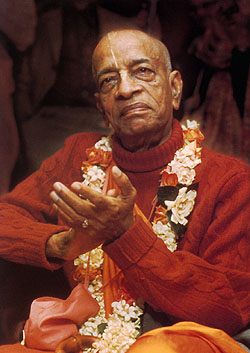
Srila
Swami Maharaja spent considerable time in Delhi before he went to
America. This is where he was printing and distributing his books. He
had published three volumes of Srimad-Bhagavatam. Several times I went
there to be with him and we stayed together in his rooms at the
Chippiwada Radha-Krishna Temple. He preached vigorously in Delhi.
Wherever he went he preached to the public. To everyone he met he spoke
about Radha-Krishna and Sri Caitanya Mahaprabhu's mission. He also
engaged me along beside him.
One day he announced to
me, "Now the time has come and I am going." He was leaving for the Port
of Calcutta and was to visit Mayapur also. I came and said good-bye and
I took his footdust and put it on my head. Before he left he requested
me to keep a regular correspondence with him, which we did. In 1965, he
went to the United States of America to preach Sriman Mahaprabhu's
message, and in July 1966 he established the International Society for
Krishna Consciousness (ISKCON).
In 1967 during his
first trip back to India he came to visit my Gurudeva, his sannyasa
guru, Srila Bhaktiprajana Kesava Goswami. At that time my Gurudeva was
in weak health and was confined to his bed in Calcutta. They had a
confidential visit then. It was their last time together in this world.
My Gurudeva was overjoyed at Swami Maharaja's devotional service to
their Srila Prabhupada. He expressed his appreciation and glorification
of Swamiji's preaching so much and pledged to cooperate in the preaching
work.
After our Gurudeva
Srila Bhaktiprajnana Kesava Maharaja departed from this world in 1968,
Srila Swami Maharaja along with his disciples sent us a telegram of
condolence. He also sent a long letter to Trivikrama Maharaja in
Navadvipa. In Seattle, Washington he delivered a lecture about our
Gurudeva. There he described the history of his awarding him sannyasa.
He wrote about how much appreciation, affection and glorification he had
for him, and how he had now entered Krishna's abode. We heard later from
some of his disciples that he shed tears when he received the telegram
telling of our Gurudeva's entering into nitya-lila.
In a short time the
branches of ISKCON were established in many countries around the world.
He wrote more than fifty books on Krishna-bhakti, which are translated
into many languages of the world. Thus, to this maha-purusa goes the
majority of the credit for spreading Sri Caitanya Mahaprabhu's
suddha-bhakti and nama-sankirtana throughout the whole world.
Srila Swami Maharaja
was becoming very ill. Our Sukananda Prabhu was offering him
naturopathic massages with Gangajala. These helped him, before he last
went abroad to England. Sukananda Prabhu came to Vrindavana for two
hours every morning and evening for fourteen days to massage him. We
also sometimes visited and spoke with Swamiji then.
Just before Kartika
month in early October when our annual Vraja Mandal parikrama was about
to begin, Srila Swami Maharaja sent for me. He requested his senior
sannyasis and many others, "I want to meet with Narayana Maharaja." They
came by car and requested me, "Srila Prabhupada wants you, so please
come now." We were just giving evening discourse for our parikrama
party, but I came immediately.
When I arrived in his
room at Krishna-Balarama Mandira, he was quite silent. Some boys were
singing the Hare Krishna maha-mantra and some sannyasis and other
disciples were silent. After some time he opened his eyes and indicated
with his eyes for me to come close. He wanted me to take a seat on his
bed. He tried to sit up but I put my hands on him and said, "Please lie
down and I will sit over here." He then motioned for me to come nearer
to his bed and said, "I want to speak to you." He wanted me to sit
closer to his ear so he told some disciples, "Bring a chair" and I sat
on it near to his ear.
First he began to weep.
His heart was melted. From the core of his heart he told me, "Narayana
Maharaja, can you excuse me? I feel that there is cause. For the sake of
preaching I have told my disciples some things which perhaps I should
not have said. Also I spoke so strongly about my Godbrothers in one
letter which was then revealed to everyone. I said that we are preaching
and others are not, that they are kanistha-adhikaris who don't preach
but are idle. I said that all the Gaudiya Vaisnavas did not help me and
they only take mahaprasadam and sleep." Swamiji had once written one
letter to me saying, "I am preaching all over the world, but they are
not doing this nor are they cooperating with me."
At this time many of
his sannyasi disciples were watching. His words and mood implied to me
many things about how he had wanted to encourage his young students. As
we are careful with babies, so he instructed them not to mix with his
Godbrothers and the other Gaudiya Vaisnavas. To save his newcomers from
becoming disturbed or confused, he sometimes told them not to visit
anywhere else because a few of his Godbrothers had done some wrong
things.
Swamiji continued, "Srila Bhaktisiddhanta Sarasvati Prabhupada ordered all of us to preach
in Europe and America. That was his strong desire. His other desire was
that we all work together to preach. I didn't waste a single moment. I
tried my best, and to some extent it has been successful." His voice was
choked with emotion. "If we can work conjointly then, as Sri Caitanya
Mahaprabhu declared, this sankirtana movement has great possibilities."
Then he told me, "I want you to help take care of my disciples. I want
them to be good and qualified devotees. If they come to you, please care
for them."
After this Swamiji told
me, "I pray to you that you will put me into my samadhi with your own
hand. I don't want to take samadhi from anyone else's hands. I think you
are the proper person. After my samadhi arrange to celebrate my
mahotsava separation festival. You should give some amount of money to
all the seven temples in Vrindavana and to all the Gaudiya Mathas. It
depends upon you, 201 rps, 1001 rps, according to your discretion,
whatever you recommend."
In his last days
Swamiji requested all of the devotees, "Take me to Govardhana. I want to
go there just now. I don't want to go by car. By bullock cart I will go,
like Nanda Baba, Yasodamaiya, like all the Vraja-vasis, like the gopis."
He wished for this opportunity; I knew this fact. But he could not go.
Actually he went there with his soul and transcendental body. He is
always there amongst Sri Rupa, Sanatana, Raghunatha, by tad-anuragi
jananugami. So this was his last wish.
When we arrived in the
final hours on November 14th, he was not speaking. I felt at that time
by seeing his face that he was fully remembering the pastimes of Krishna
in Vrindavana. I think it was great mercy coming from Krishna because
for his whole lifetime he had served Radha-Krishna. For that special
person, Krishna absorption is there. Entranced in this way, his eyes
were closed and he was exhibiting special symptoms. It was a very
touching (karuna) scene. He had no pain, no distraction. At that time
his mouth was so beautiful- like a blossomed rose, like a lotus. These
are the signs of a very great personality. There are signs, particular
signs at that moment which show someone is remembering Krishna, and
Swami Maharaja was exhibiting all those signs. He was very beautiful,
very high-class.
Our brahmacaris were
softly singing some bhajanas. At that time I saw that he was fully
satisfied, and thus I was also fully satisfied. I knew then that he
would surely go soon, but there was no sign when he would go; he would
leave now or in a short time. Before, he had talked with me when he was
in his external senses, but he did not request me to stay. I was not in
a hurry, but I was thinking that just after my leaving for Mathura he
would enter into nitya-lila. We left to return to Mathura and then we
were informed that he departed a few hours later.
Shortly after that time
we returned to the Krishna-Balarama Mandir and made all arrangements for
his mahotsava. According to his wishes we took him on procession in
front of most of the important deities of Vrindavana. There were so many
of his disciples and other persons chanting in that procession. All of
the Vraja-vasis came into the streets to honor him. After this, I
prepared his body. I wrote the special mantras on his chest and forehead
with tilaka. I used the salt for his body. Then, following all of the
proper Vaisnava procedures, I put his transcendental body into samadhi
with my own hand.
----Srila
Bhaktivedanta Narayana Maharaja
|
|
|
Movies
19960623
FULLERTON CA SPEAKING ABOUT SRILA PRABHUPADA HIS SWAMIJI.wmv
19961114
DISAPPEARANCE DAY SRILA PRABHUPADA.wmv
1996NY_ABOUT
SRILA PRABHUPADA_TAPE1.wmv
19990110FIJI
ISKCON TEMPLE ABOUT SRILA PRABHUPADA.wmv
MP3 Lectures
19771114VRINDAVAN
CHANTING AFTER SRILA PRABHUPADA RETURNS PM.mp3
19911110SRILA
PRABHUPADA DISP DAY WITH SBNM AND TKG.mp3
19921002
and Aug 12 with SDG GAYATRI MANTRA AND FAITH IN SRILA PRABHUPADA.mp3
19921115 AND 20 BOMBAY TALK IN SRILA PRABHUPADAS ROOM EKADASI
DARSHAN PM TAPE10.mp3
19921120_21BOMBAY SB 10_31_8 CONT NOV 20 EKADASI TALK IN SRILA
PRABHUPADAS ROOM P1.mp3
19960517UK_RADLETT_VISIT_SRILA_PRABHUPADA'S_ROOM_A.mp3
19960906SRILA_PRABHUPADA_APPEARANCE_DAY_MATHURA.mp3
19960927MATHURA_SRILA_PRABHUPADA_SANNYASA_ANNIVERSARY_A.mp3
19960927MATHURA_SRILA_PRABHUPADA_SANNYASA_ANNIVERSARY_B.mp3
20001021AKRURA_GHAT_USING_THE_NAME_PRABHUPADA.mp3
2000131VARSANA SRILA AC BHAKTIVEDANTA SWAMI PRABHUPADAS DISP AM
AND PM TAPES 1736 1737.mp3
20021108VARSANA DISP SRILA BV SWAMI MAHARAJA PRABHUPADA.mp3
Srila Prabhupada Lecture
"Krsna Is Equal To Everyone"
Srimad-Bhagavatam 1.8.28
Los Angeles, April 20, 1973
listen
Devotee:
manye tvam kalam isanam
anadi-nidhanam vibhum
samam carantam sarvatra
bhutanam yan mithah kalih
"My Lord, I consider Your Lordship to be eternal time, the Supreme
Controller, without beginning and end, the all-pervasive one. In
distributing Your mercy, You are equal to everyone. The dissensions
between living beings are due to social intercourse."
Prabhupada: In the Bhagavad-gita Krsna says exactly the same thing.
This is explained by Kunti, a devotee. The same thing is spoken by
the Lord Himself. Samo 'ham sarva-bhutesu na me dvesyo 'sti na
priyah, ye tu bhajanti mam bhaktya tesu te mayi. God cannot be
partial. That is not possible. Everyone is God's son. So how God can
be partial to one son and, better than the other son? That is not
possible. That is our mistake. We write: "We trust in God," but we
make discrimination. If you trust in God, then you must be equally
kind and merciful to all living entities. That is God consciousness.
So Krsna says: "I have no enemies, neither I have got friends." Na
me dvesyo 'sti na priyah.
Dvesya means enemy. We, we are envious of our enemy and we are
friendly to our friends. So Krsna is absolute. Even He appears to be
inimical to some demon, actually He's friend. When a demon is
killed, that means his demonic activities are killed. He becomes a
saint immediately. Otherwise how he's promoted immediately to the
brahmajyoti? All these demons who were killed by Krsna, they
immediately merge into the brahmajyoti-nirvisesa. The only
difference is, of course, the brahmajyoti, Paramatma and Bhagavan.
They are one. Vadanti tat tattva-vidas tattvam [SB 1.2.11]. That is
one truth, Absolute Truth, in different features only. Brahmeti
paramatmeti bhagavan iti sabdyate. Originally Bhagavan, His plenary
representation is Paramatma who is situated in everyone's heart.
Isvarah sarva-bhutanam hrd-dese 'rjuna tisthati [Bg. 18.61]. The
plenary portion Ksirodakasayi Visnu, He is in everyone's heart. That
is Paramatma. And Brahman, Paramatma, and Bhagavan. The ultimate
issue is Bhagavan. So ye yatha mam prapadyante. Now He's equal to
everyone. It is up to the devotees or persons who are trying to
understand the Supreme Absolute Truth. According to their capacity
of understanding, the Absolute Truth, God, is revealed, either as
impersonal Brahman or localized Paramatma or Bhagavan. It is up to
me.
The same example as I have repeated many times. Just like we see
sometimes the hills from our room. Here there are many hills in Los
Angeles. But they are not distinct. When you are seeing the hills
from a distant place, it looks like something cloudy. But if you go
still further towards the hill, you'll distinctly find that there is
something, hill. And if you come to the hill, then you'll find so
many persons are working there, so many houses are there. There are
streets, motorcars, everything, all varieties. So similarly, when
one wants to know the Absolute Truth by his teeny brain, "I shall
make research to find out the Absolute Truth," then you'll have
vague idea, impersonal idea. And if you become a meditator, then you
will find that God is situated within your heart.
Dhyanavasthita-tad-gatena manasa pasyanti yam yoginah [SB 12.13.1].
The yogis, the real yogis, they, by meditation, they see visnu-murti
within the heart. And those who are devotees, they meet the Supreme
Person face to face just like we are meeting face to face, talk face
to face, serve directly. The Supreme Personality of Godhead orders
that: "You supply me this," and he supplies. That is the difference.
So samo 'ham sarva-bhutesu. He's equal to everyone. Now it is up to
you to understand Him according to your capacity. So Kunti also says
the same thing in this verse: samam carantam sarvatra. Samam
carantam. Carantam means moving. He is moving everywhere, outside,
inside, simply we have to make our eyes clear to see Him. That is
devotional service, to make our senses purified to perceive the
presence of God. God is present everywhere. Antar bahih. Antah means
within and bahih means without. "Those who are less intelligent,
they simply try to find out God within, and those who are advanced
in intelligence, they can see You within and without." That is the
difference.
Meditation is meant for the less intelligent class of men.
Meditation means you have to control the senses. Yoga practice means
yoga indriya-samyama. Our senses are very restless. By yoga
practice, by, I mean to say, practicing different asanas, so mind is
controlled, the senses are controlled. Then we can concentrate upon
the form of Visnu with our heart. That is yoga system. Or those who
are too much in bodily concept of life, for them the yoga system is
recommended, practicing the bodily exercise, and find out the
Supreme Lord within the heart. But bhaktas, those who are devotees,
who are still more advanced, they don't require to control their
senses separately, because to be engaged in devotional service means
controlling the senses.
Suppose you are engaged in worshiping the Deity, in cleansing the
room, in decorating the Deity, in making foodstuff for Deity,
everything nicely... So your senses are already engaged. Where is
the chance of your senses being diverted? The senses are already
controlled. Because my senses, hrsikena hrsikesa-sevanam bhaktir
ucyate [Cc. Madhya 19.170]. Bhakti means simply to engage the senses
in the service of the master of the senses. Hrsikesa means master of
the senses, and hrsika means senses. So now our senses are engaged
for sense gratification. Sarvopadhi, upadhi yuktah. So I am this
body. So I must satisfy my senses. This is the contaminated stage of
life. But when one comes to the understanding that I am not this
body, I am spirit soul, part and parcel of God, so my senses,
spiritual senses, should be engaged in the service of the Supreme
Spiritual Being. That is wanted.
That is mukti. Mukti means: hitva anyatha-rupam. When we are
conditioned, we give up our original constitutional position. Our
original constitutional position is, as Caitanya Mahaprabhu says:
jivera svarupa haya nitya-krsna-dasa [Cc. Madhya 20.108-109]. Our
original constitutional position is that we are eternal servant of Krsna. So as soon as we employ ourself in the service of the Lord,
immediately we become liberated. Immediately. there is no question
of passing through some process. This very process, to engage
oneself, engage one's senses in the service of the Lord, means he is
liberated.
So this liberation is open for everyone. Samam carantam. Krsna does
not say that: "You come to Me. You become liberated." No. He's open
for everyone. He says: sarva-dharman parityajya mam ekam saranam
vraja [Bg. 18.66]. He speaks to everyone. Not that He's speaking to
Arjuna only. He's speaking to everyone. Bhagavad-gita is spoken not
only for Arjuna. Arjuna is the, just like the target. But it is
spoken for everyone, for all human beings. So one has to take
advantage. Samam carantam. He's not partial that: "You become..."
Just like the sunshine. The sunshine is not partial that: "Here is a
poor man, here is a low-class man, here is a hog. I shall not
distribute my shining there." No. Sun is equal. One has to take
advantage of it. The sunshine is there open, but if you close your
door, if you want to keep yourself in airtight darkness, that is
your business.
Similarly Krsna is everywhere. Krsna is for everyone. Krsna is ready
to accept you as soon as you surrender. Samam carantam. There is no
restriction. Krsna says: mam hi partha vyapasritya ye 'pi syuh
papa-yonayah [Bg. 9.32]. They make distinction that this is lower
class, this is higher class. So Krsna says, "Even lower class,
so-called lower class, it doesn't matter, if he takes to Me, then
he's also eligible to go, come back to home, back to Godhead." Samam
carantam.
And He's the eternal time. Everything is going on within the time.
The time... Our time calculation is past present, and future. This
is relative. The other day we were discussing. This past, present,
future is relative term. The, for a small insect, the past, present
and future is different from my past, present and future. Relative
term. Similarly Brahma's past, present and future is different from
my past, present and future. But Krsna has no past, present and
future. Therefore He's eternal. We have got past, present and future
because we change this body. Now we have got this body... It has got
a date. In such and such date I was born by my father and mother.
Now this body will stay for some time. It will grow. It will produce
some by-product. Then it will become old. Then dwindle. Then vanish,
finish. No more this body. You accept another body. this body's
finished. The history of this body, past, present, and future,
finished. You accept another body. Again your past, present and
future begins. But Krsna has no past, present, futures because He
does not change His body. That is the difference between ourself and
Krsna.
Just like Krsna spoke to Arjuna that: "In the past, I spoke to the
Sun-god about this philosophy, Bhagavad-gita." So Arjuna could not
believe it. Arjuna knew everything, but for our, our education, he
put this question that: "Krsna, we are contemporary, we are born
practically in the same period. How can I believe that You spoke
this philosophy to the Sun-god?" And the reply was that: "My dear
Arjuna, you were also present there, but you have forgotten. I have
not forgotten. That is the difference." Past, present, future, for
persons who forget. But who does not forget, who remains eternally,
there is no past, present, future.
Therefore, Kunti is addressing Krsna as eternal. Manye tvam kalam.
And because He is eternal, isanam, He is full controller. Kunti
says: manye, "I think..." By the behavior of Krsna, she could
understand that Krsna is eternal, Krsna is the Supreme Controller.
Anadi-nidhanam. Anadi-nidhana... There is no beginning, there is no
end. Therefore vibhum. Vibhu means the Supreme, the greatest. Vibhu.
We are anu, we are smallest, and Krsna is the biggest. Krsna is
also, because we are part and parcel of Krsna. Therefore Krsna is
both the smallest and the biggest. We are simply smallest. But Krsna
is both. Krsna, vibhu, greatest means all-inclusive. In the great,
if you have got a big bag, you can hold so many things. In small bag
you cannot do that.
So Krsna is vibhu. He includes the time, past, present and future.
He includes everything and He's everywhere. That is vibhu. Vibhu,
all-pervading. Krsna is everywhere.
Andantara-stha-paramanu-cayantara-stham. In the Brahma-samhita it is
said that Krsna... Because without Krsna, the matter cannot develop.
The scientists, the atheist scientists, they say that life comes out
of matter. That is nonsense. No. Matter is one energy of Krsna, and
spirit is another energy. The spirit is superior energy, and the
matter is inferior energy. The matter develops when there is
superior energy.
Just like this country, America. The same America was two hundred
years ago, three hundred years ago, the land, but it was not
developed. But because some superior living entities from Europe
came here, now America is so much developed. Therefore the cause of
development is the superior energy. The inferior energy, there are
so many vacant land lying still. Just like in Africa, Australia.
They're called "undeveloped." Why undeveloped? Because the superior
energy, living entity, has not touched it. As soon as the superior
energy, living entity, will touch it, the same land will develop so
many factories, houses, cities, roads, cars, everything, as we can
develop.
Therefore the conclusion is that matter cannot develop out of
itself. No. That is not possible. The superior energy must touch it.
Then it will be, will, active. There are so many machines. That is
matter. Inferior energy. Unless a operator comes to touch the
machine, it will not act. First-class motor car, very costly motor
car machine, but unless a driver comes, it will stand for millions
of years there. There is no use. This common sense is lacking. The
matter cannot work independently unless the superior energy, living
entity, touches it. This is common sense. So how these rascal
scientists say that life develops from matter? No. How it can be
concluded? There is no such instances. They falsely say that... They
do not have sufficient knowledge.
So these universes, they have also developed on account of Krsna's
presence. Therefore Brahma-samhita says:
andantara-stha-paramanu-cayantara-s... They are studying now atoms.
So many things are going on, electrons, protons, Why? Because the
Krsna is there. This is really science. So Krsna has no past,
present and future. He is eternal time. He has no beginning. He has
no end. And He is equal to everyone. Samam carantam. Simply we have
to prepare ourself to see Krsna, to understand Krsna. That is the
business of Krsna consciousness.
Thank you very much. (end)
>>> Ref. VedaBase => Srimad-Bhagavatam
1.8.28 -- Los Angeles, April 20, 1973
"The Whole Thing In One
Word"
Srimad-Bhagavatam 1.8.33
Mayapura, October 13, 1974
listen
Nitai: "Others say that
since both Vasudeva and Devaki prayed for You, You have
taken Your birth as their son. Undoubtedly You are
unborn, yet You take Your birth for their welfare and to
kill those who are envious of the demigods."
Prabhupada:
apare vasudevasya
devakyam yacito 'bhyagat
ajas tvam asya ksemaya
vadhaya ca sura-dvisam
There are... Actually Krsna is unborn, aja, but Aja is
taking birth. That is already explained. This is the
bewilderment, vidambanam. It is already explained. So
this vidambanam, speculation or bewilderment, how many
types of speculation are there, that is being described
by Kuntidevi. Somebody says that Krsna is Yadava.
Yadava. Yadavaya madhavaya kesavaya namah. Yadava means
born in the Yadu dynasty. And somebody says Krsna is
Vasudeva, son of Vasudeva, Devaki. And Krsna... And some
of them, they say, nanda-kumaraya, now, son of Nanda
Maharaja. So Krsna has many speculations, but actually
He is aja. Ajas tvam asya ksemaya.
Krsna... This is to be understood, that everyone
thinking that He is born in the Yadu family, He is born
of Vasudeva, or He is the son of mother Yasoda and Nanda
Maharaja. This is Krsna's pastime. When the
impersonalist says, or there are many philosophers, that
"God has no name," actually that is a fact. God has no
name. But He has name according to His activities. Just
like when He acts as the chariot driver of Arjuna, His
name is Partha-sarathi. When He plays as the child of
mother Yasoda, He is called Yasoda-nandana. When people
say that He is born of Nanda Maharaja, He is called
Nanda-nandana. When people say that He came to protect
Vasudeva and Devaki, He is called Vasudeva, or
Devaki-nandana. Or when He is in the Yadu dynasty, He's
said as Yadava. In this way, Krsna has unlimited
pastimes and unlimited names. Advaitam acyutam anadim
ananta-rupam [Bs 5.33]. Ananta. Ananta means unlimited.
He has got unlimited because so many devotees, not one
devotees, and He has to satisfy everyone, as
Nanda-kumara, as Yasoda-nandana, as Vasudeva, as Yadava,
as Partha-sarathi. So in this way, when one becomes
bewildered that how many names He has got, so one should
understand He has unlimited names or no name, but
because He has to act unlimitedly, therefore He has got
unlimited names.
So whole thing is summarized in one word: "Krsna," means
all-attractive. He draws the attraction of Vasudeva. He
draws the attraction of Yadu-kula. He draws the
attraction of Arjuna. He draws attraction of everyone,
all devotees. Mama vartmanuvartante partha sarvasah. The
whole world, civilized world, they have got some
religion -- Christian religion, Muhammadan religion,
Hindu religion, Buddhist religion, and many other
subordinate religions. Under the groups of Christian,
there are so many churches -- Protestant, Catholic. In
the Muhammadans, they have got Shiya, Suni, Sek,(?) so
many. In Hindus also, Vaisnavas and Saktas and Sauras,
Ganapatyas, so many. But Krsna says that "All of them,
seeking after Me." Mama vartmanuvartante partha
sarvasah: "Everyone, they may go on under different
religious systems, but the aim is how to approach Me."
Vedais ca sarvair aham eva vedyah [Bg. 15.15].
If you take... Veda means knowledge, scripture. Veda
does not mean any particular scripture. Any scripture
which gives knowledge of God, you can call it as Veda.
Vedais ca sarvaih. If any book or any scripture or any
book of knowledge does not give the information of God,
that is not scripture because it cannot be called
scripture, or Veda, because it does not search after the
Supreme Being. Therefore Krsna says, vedais ca sarvair
aham eva vedyah [Bg. 15.15]. Bahunam janmanam ante
jnanavan mam prapadyate, vasudevah sarvam iti [Bg.
7.19]. This is the ultimate goal of knowledge.
So you can call the Supreme Lord Krsna or something
else. Just like Muhammadans, they say "Allah." Allah
means "the Supreme Being." Allah akbar. And the
Christian says "God is great." And we say param brahma
param dhama [Bg. 10.12], or Krsna, all-attractive. But
the aim is to understand Krsna, that Krsna personally
appears so that your misgivings, misunderstandings may
be mitigated immediately -- "Here I am." The Krsna
consciousness movement is for this purpose, that "You
religionists, you philosophers, you scientists, you
speculators, you are all... theosophists, so many, you
are searching after God, and here is God, Krsna." But
they are so unfortunate, they'll not accept it. "No, why
shall I accept Krsna as God?" Then why you shall not?
That is our question. If you do not accept Krsna as God,
then you must know what is God. That, if I ask him, "Do
you know what is God?" "That I do not know."
The same... Just like the scientist. He would propose
that life is made by combination of chemicals, but when
another scientist says, "Suppose I give you the
chemicals. Can you produce life?" he will, the rascal
will say, "That I cannot say." Similarly, they are
rascals. We are presenting herewith, "Here is Krsna.
Take His address. Take His name. Take His father's name,
mother's name, all identification, His activities, His
glories, everything." Krsna proves that He's the Supreme
Personality of Godhead:
aisvaryasya samagrasya
viryasya yasasah sriyah
jnana-vairagyayos caiva
sannam bhaga itingana
Bhagavan. Bhagavan means the proprietor of all wealth,
aisvarya, samagrasya. Not any limited amount, but
samagra, everything. Krsna says that. Bhoktaram
yajna..., sarva-loka-mahesvaram: "I am the proprietor of
all the planets." Krsna says that. So you check Him,
that "How He is the proprietor of all the planets?"
Therefore He showed Visvarupa, the universal form, how
everything is within Him.
Everything is there. Arjuna wanted, requested Krsna,
that "How I can understand that You are the proprietor,
You are the everything in the universe?" So He showed
His universal form. Krsna showed in every way to fulfill
the proper definition of God, aisvaryasya samagrasya,
proprietor of everything, and viryasya, the powerful.
Nobody could kill Krsna, but He killed so many demons,
big, big demons. Therefore He's powerful. And His
reputation? Still continuing, Krsna. We are selling
Krsna book like anything. Why people are interested with
Krsna? Because He is reputed. People are seeing. The
Krsna consciousness movement is going on all over the
world. This is yasah.
So when Krsna was present, who could compete Him with
His opulence? He had 16,108 wives, not loitering in the
street, but each and every wife had big, big marble
palaces, all marble palaces. Furniture with ivory, ivory
and silk, and frames, all golden, garden with parijata,
so many things. The... And not one palace, two palace.
Sixteen thousand palaces. And Narada was surprised:
"What Krsna is doing with sixteen thousand wives?" In
each and every palace he entered, and he saw Krsna is
engaged in different way. Somebody is taking care of the
children; somebody... Somewhere He is arranging for the
marriage of His son and daughter. Somewhere He is
engaged in other sixteen thousand..., in the sixteen
thousand palaces, in sixteen thousand engagements, and
queens. So this is called opulence, aisvarya. Who can
show this? And Krsna showed it personally.
So in every way Krsna proved the Supreme Personality of
Godhead. Still, these rascals, they are searching after
God. What is this nonsense? Here is God. You see that He
is God in every respect according to the definition, and
still, you say that "Where is God?" How much rascal they
are, just imagine. Here is God, and still, they are
enquiring, "What is God? Can you show me God?" What is
this? Is it not rascaldom? What is this? If everything,
proof is there, why they are searching after God? What
is the answer? Where is the question of searching after
God? Just answer this question. God is present here, and
still, you are wasting your time. Therefore Krsna says,
mudha. Mudha. Na mam duskrtino mudhah [Bg. 7.15]. Simply
rascal. They cannot be given any other title except this
one title, mudhah. Why they remain mudhah? Why are they
are not intelligent? They are being educated in the
universities, getting so many degrees. Still, they
remain mudhah. Why? Duskrtinah, sinful, engaged in
sinful activities, these sinful activities. Yatra papas
catur-vidha. Every one of them, all these rascals,
are... They're engaged in four kinds of sinful
activities. They'll search after illicit sex, they will
eat meat, and they will drink and they will play
gambling. Just one after a... You just study. They
cannot understand God because they are mudhah.
Why they are mudhah? Because they are sinful. Why they
are sinful? Because naradhamah, lowest of the mankind.
Human form of life was given to him to become purified,
but they are engaged in sinful activities so that next
life they'll be cats and dogs and hogs and trees. Why
trees? Trees stands naked. And now this nudie movement
is there, how to remain naked. That means next life they
are preparing for becoming tree: "Thousand years, stand
up here, naked. Nobody will object." Yes, this is the
law of nature. Prakrteh kriyamanani gunaih karmani
sarvasah [Bg. 3.27]. These rascals... Because the
rascals, they do not know. And even the information is
there, still, they'll not accept. This is their
position.
So don't remain mudhah. This is Krsna consciousness
movement. Krsna consciousness movement is to educate
people not to remain mudhah. Be intelligent. It is a
very nice cultural movement that it is trying to awaken
people to their God consciousness. "Here is God." This
is the sum and substance of Krsna consciousness. And the
process is also bona fide because Krsna Himself is
teaching the process. Krsna, first of all, generally He
told, sarva-dharman parityajya [Bg. 18.66], because this
is the process. But because they are mudhas, rascals and
sinful, they could not understand. They could not
understand. Therefore Krsna came personally to teach
people how to surrender. That is Caitanya Mahaprabhu.
Apani acari prabhu jivere sikhaya.
namo maha-vadanyaya
krsna-prema-pradaya te
krsnaya krsna-caitanya-
namne gaura-tvise namah
[Madhya 19.53]
Rupa Gosvami could understand that "Here is Krsna, Sri
Caitanya Mahaprabhu." Krsnaya. Now He is acting as
Krsna-caitanya. Krsnaya krsna-caitanya-namne: "He has
assumed the name of Krsna-caitanya, but He is Krsna
Himself." And what He is doing? Because previously, as
Krsna, He simply ordered that "You surrender. Then
you'll be purified and you'll be promoted." Now here, as
Krsna-caitanya, He is giving krsna-prema. Krsna-prema.
Unless I understand you very thoroughly, how there can
be love for you? Love is not so easy that simply by
meeting, or one day's transaction, one becomes lover of
other. No. It takes time. So in the Krsna form, Krsna,
the Supreme Lord, He simply wanted that "You surrender;
then you'll understand Me." But in the Caitanya
Mahaprabhu, not only understanding Him, but one gets
love of Krsna, the highest stage. Therefore He is
addressed as namo maha-vadanyaya, the topmost charitable
personality. He is giving krsna-prema.
So the process is there. And actually it is so happening
all over the world. How the Christian priests are
surprised that "These boys, these Christian boys or
these Jewish boys, they never came to the church. They
did not inquire even what is God. Now they have left
everything and they are mad after God. How it is po...
How it is?" Because we have adopted the process
enunciated by Sri Caitanya Mahaprabhu; therefore it has
become easier. Otherwise, to understand Krsna only, it
will take millions of years, simply to understand Krsna.
And what to speak of becoming lover of Krsna? If I do
not understand you, I cannot become your lover. You...
We cannot love an unknown person. Is it possible? You
must know him. You must behave with him. You must study
him. He will study you. Then there is question of love.
But Krsna-caitanya Mahaprabhu has given us such a nice
process: ceto-darpana-marjanam [Cc. Antya 20.12]. By
chanting Hare Krsna mantra, immediately...
Because we do not love Krsna... We have got intimate
relationship with Krsna as part and parcel. It cannot be
separated. It cannot be separated. But any way, some way
or other, we have lost or forgotten that intimate
relationship with Krsna. Nitya-siddha krsna-bhakti. That
is nitya-siddha, eternally fact, that Krsna loves us and
we love. Krsna loves. Therefore He comes personally. He
comes as devotee to deliver us back to home, back to
Godhead. Unless He loves, how it is possible? Krsna is
coming in so many ways. He is sending His devotee. He is
leaving Bhagavad-gita for study to understand Krsna.
That is... Krsna loves. Simply teaches that... Therefore
Caitanya-caritamrta says that nitya-siddha krsna-bhakti.
This krsna-bhakti, love of Krsna, it is not something
that artificially trained up. Artificial things...
Now these American and the European boys, they are after
me. They are after this for the last six, seven years.
Had it been an artificial thing, they could not stay.
That is not possible. It is not artificial. It is
already there, Krsna. Krsna-bhakti nitya-siddha. It is
already there. By the process of Caitanya Mahaprabhu, I
am simply trying to awaken that krsna-bhakti. That's
all. That is the duty of guru. Caksur unmilitam yena. He
opens the eyes, that "Why you have forgotten Krsna? Here
is Krsna. You love Him. You'll be happy." This is guru's
business. Not that he is giving artificially something
which is known as krsna-bhakti. Krsna-bhakti's already
there. Nitya-siddha krsna-bhakti sadhya kabhu naya,
sravanadi-suddha-citte. Simply by this process, hear
about Krsna. That we have introduced. In our so many
centers this process is going on: hear about Krsna,
chant about Krsna. Simply "Krsna, Krsna, Krsna, Krsna."
Srnvatam sva-kathah krsnah [SB 1.2.17]. Then Krsna will
help you.
So this is Krsna. So the highest devotees, they...,
Krsna, they, Krsna accepts because He is playing the
part of human being. Avajananti mam mudhah. Those who
are mudhas, they cannot understand, but those who are
intelligent, they know that Krsna is perfectly playing
as a human being. As a human being takes birth in the
womb of his father and mother by the father and mother,
similarly, Krsna also appeared, accepting Vasudeva as
His father, Devaki as mother. But actually Krsna is not
born. That is being repeatedly explained by Kuntidevi,
that apare, apare vasudevasya devakyam: "They say like
that." What is that? Devaki-nandana... There is a verse,
that "It is a saying only. Nobody can become Krsna's
father or mother, but they get the reputation as father
and mother. That is a concession to the devotee."
Therefore, Kuntidevi says, apare: "Others say like
that." Somebody says like this; somebody says like that;
somebody says like this. This is going on. But actually,
Krsna remains aja always. Because if we do not
understand that Krsna, what is Krsna, then we'll
misunderstand Him, that "He is also born. He is also
born, so how He can become?" The Mayavadis say that
"Krsna is also having a body of the material body, maya.
Therefore real spiritual identity (is) impersonal. As
soon as He assumes the body, it is material." That is
called Mayavada. "Maya. The Krsna's body is maya. The
ultimate Absolute is no body, impersonal." That is their
theory. Therefore we call them Mayavadi.
But they do not actually know that ultimately the
Absolute Truth is a person, the Supreme Person,
Bhagavan. Brahmeti paramatmeti bhagavan iti sabdyate.
Vadanti tat tattva-vidas, tattva-vidah [SB 1.2.11].
Tattva means one who knows tattva. They know that
ultimately the Absolute Truth is person, not imperson.
Therefore Bhagavata says, vadanti tat tattva-vidas
tattvam [SB 1.2.11]. What is the Absolute Truth?
Absolute Truth means tattvam. So Bhagavata says, vadanti
tat tattva-vidah: "Those who are aware of the Absolute
Truth, they say like this." What is that? Brahmeti...
Yad, yaj jnanam advayam. Advayam: "He is without any
duality, but the Absolute Truth is known as in three
features: by somebody as Brahman, by somebody as
Paramatma, and somebody as Bhagavan."
Actually He is Bhagavan. Paramatma is His universal
feature.
eko 'py asau racayitum jagad-anda-kotim
yac-chaktir asti jagad-anda-caya yad-antah
andantara-stha-paramanu-cayantara-stham
govindam adi-purusam tam aham bhajami
[Bs. 5.35]
Eko 'py asau, only one portion. That is also confirmed
in the Bhagavad-gita, athava bahunaitena kim jnatena
tavarjuna, vistabhyaham... [break] ...this universe is
only one only. That also, we cannot estimate what is the
length and breadth, how many planets are there, and
still, we are proud of becoming God. But God creates
such millions of universes. Eko 'py asau racayitum
jagad-anda-kotim. Koti, million. Yac-chaktir asti
jagad-anda-caya yad-antah. He is creating, and
everywhere He is present. How He is present?
Andantara-stha. He's present within the universe and
within the heart of all living entities, even within the
atom. Andantara-stha-paramanu-cayantara... That is
Krsna. That is only by His one part. Govindam
adi-purusam tam aham bhajami **.
So such Govinda has become the son of Vasudeva and
Devaki. So how it is possible? And therefore the devotee
is so great that although Krsna, or God, is so great
that by His one portion He can create the innumerable
universes, He enters into the womb of Devaki and comes
out as her son. This is Krsna's grace. You see. He can
make His devotee so great that the greater than the
greatest is coming out of the womb of Devaki. So apare
vasudevasya devakyam. And why He agreed? Yacitah,
yacitah: "requested." Requested as Sutapa and Prsni.
Vasudeva was Prsni in his former life, and Devaki was
Sutapa. Sutapa. Sutapa means one who can perform
austerities and penance very nicely. Su means nicely,
and tapah. So they underwent austerities and penance to
get a son like Krsna.
So when Krsna was pleased with their tapasya, they
wanted: "My Lord, we want a, a son like You." "So where
is like Me?" Krsna is asamordhva. There is nobody equal
to Krsna; nobody is greater than... Otherwise, how He
can be great? If somebody is greater than Him, then how
He can be great? Nobody can be greater than Him. That is
greatness, either you say in English language or
Muhammadan language. Allah akbar: "Allah, the Supreme
Being, is the great." We also say, param brahma. So
nobody can be greater than Him or equal. Asamordhva. So
they wanted "a son like You." That means somebody must
be equal to Him. "Like You" means equal to Him. So who
can be equal to Krsna? But He can expand Himself with
many equals. Advaitam acyutam anadim ananta-rupam [Bs
5.33]. Krsna can expand Himself in millions' and
millions' forms. Goloka eva nivasaty akhilatma-bhutah
[Bs. 5.37]. Everything is there. Although He is living
in Goloka, still, by His omnipotency, omnipresence, He
can be everywhere. Andantara-stha-paramanu-ca... So that
Paramatma, or the Supersoul, is equal with Krsna. Not
anything else equal with Krsna, but the Paramatma is
equal with Krsna. Therefore by His expansion, He agreed
to become son of Devaki, and there may be hundreds and
thousands of Devaki, devotees. He is unlimited. His
devotees are unlimited. Their demands are unlimited.
So everything is Krsna's unlimited. So therefore
all-unlimited means Krsna, all-attractive. That is the
real name of God, if God can be given one name. Because
God has no name, but His names are given according to
His activities. Then how to concentrate in one name?
That one name is Krsna, all-attractive. That is the real
name of Krsna.
Thank you very much. Hare Krsna. (end)
>>> Ref. VedaBase =>
Srimad-Bhagavatam 1.8.33 -- Mayapura, October 13, 1974
|
|
|